Why tax assumptions can make or break ROI
Many investors validate deals using pre-tax yields and only later discover that real performance is materially lower. Taxation is not a side detail; it is a structural layer that affects available cash flow.
In 2026, a reliable process is to separate gross yield, net before tax, and net after tax. Without this separation, you risk approving deals that look attractive but are fragile in reality.
This guide gives a practical way to integrate tax conservatively in your ROI model.
Do not mix gross, net, and net-after-tax
Gross yield is useful for quick screening, but it ignores most real costs. Net yield deducts recurring operating expenses: building management, maintenance, insurance, the local tax, and vacancy. Net-after-tax then adjusts for tax and related obligations tied to rental income.
That final layer is what you actually keep. If debt is involved, compare it to your own cash invested to evaluate final cash-on-cash. Two properties showing the same 6% gross yield can land more than a point apart once the regime, the local tax and the vacancy assumption are applied to each.
In our ROI calculator, you can model a conservative tax reserve on top of your net cash flow to avoid overestimation.
What to provision beyond basic expenses
Beyond headline income tax, landlords should anticipate local tax-related charges, administrative costs, possible regularization items, and compliance overhead. The exact weight depends on the asset type, the regime you elect, and your personal tax situation, so a single blanket percentage rarely fits every property in a portfolio.
A common mistake is treating these as rare exceptions. In practice, they should be built into your yearly budget from day one, on the same footing as building charges or maintenance. A landlord who books them only when the assessment notice lands will keep revising the yield downward year after year.
A reserve-based approach is safer: allocate a prudent share of rental income for tax and compliance obligations. That reserve makes the plan more resilient and removes the end-of-year surprises that force owners to dip into personal savings to settle a bill they never modelled.
Long-term vs short-term rentals: different tax pressure
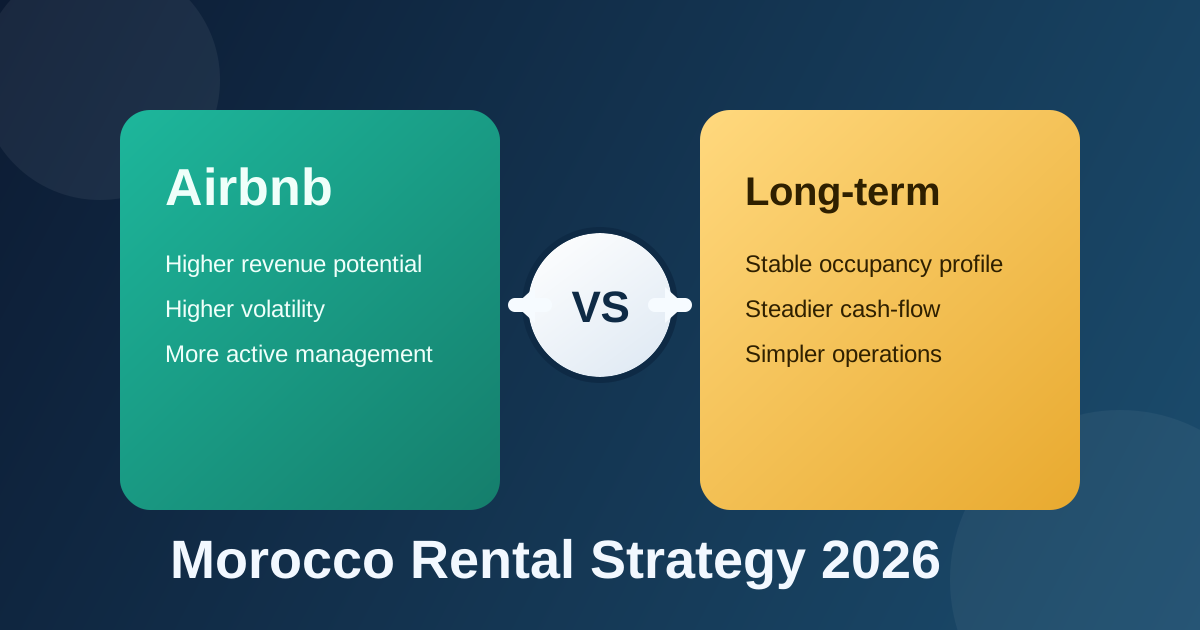
Long-term and short-term rental models do not carry the same operational and tax dynamics. Short-term can deliver higher gross income, but obligations and management intensity are usually higher.
When comparing models, do not compare only gross revenue. Compare income that remains after operating and tax assumptions.
Run two separate scenarios in the calculator: same asset, different operating mode, different prudent tax range.
Simple method to model tax impact
Step 1: calculate net cash flow before tax with conservative vacancy. Step 2: apply a tax reserve range (low/high) based on your situation. Step 3: confirm the project remains acceptable in both cases.
Range-based modeling is stronger than one optimistic assumption. It gives decision-ready boundaries instead of false precision.
You can execute this quickly using our Morocco ROI simulator.
Illustrative example
Assume net-before-tax cash flow of 48,000 MAD/year. If your tax-related reserve range is 10% to 18%, available cash flow becomes roughly 39,360 to 43,200 MAD/year.
That gap can move your cash-on-cash result by more than one point depending on leverage and acquisition costs. This is why gross-only analysis is risky.
Test both bounds in the ROI tool before final commitment.
Frequent investor mistakes
Mistake one: postponing tax modeling until after purchase. Mistake two: confusing collected rent with true available income. Mistake three: keeping no reserve for adjustments.
Mistake four: overestimating rent and underestimating vacancy, which magnifies tax-model error. Mistake five: using the same assumptions for long-term and short-term models.
The fix is straightforward: prudent assumptions, scenario ranges, and periodic updates with real numbers.
Tax-focused pre-investment checklist
Checklist
- Define operating model (long-term or short-term).
- Compute net-before-tax with prudent vacancy.
- Add a low/high tax reserve range.
- Validate cash flow after this adjustment.
- Keep annual liquidity reserve for regularization.
This does not replace professional advice, but it removes the most costly planning errors.
Apply this checklist, then confirm the deal in the main ROI calculator.
Flat-rate regime (40% allowance) or actual-expenses regime: how to decide
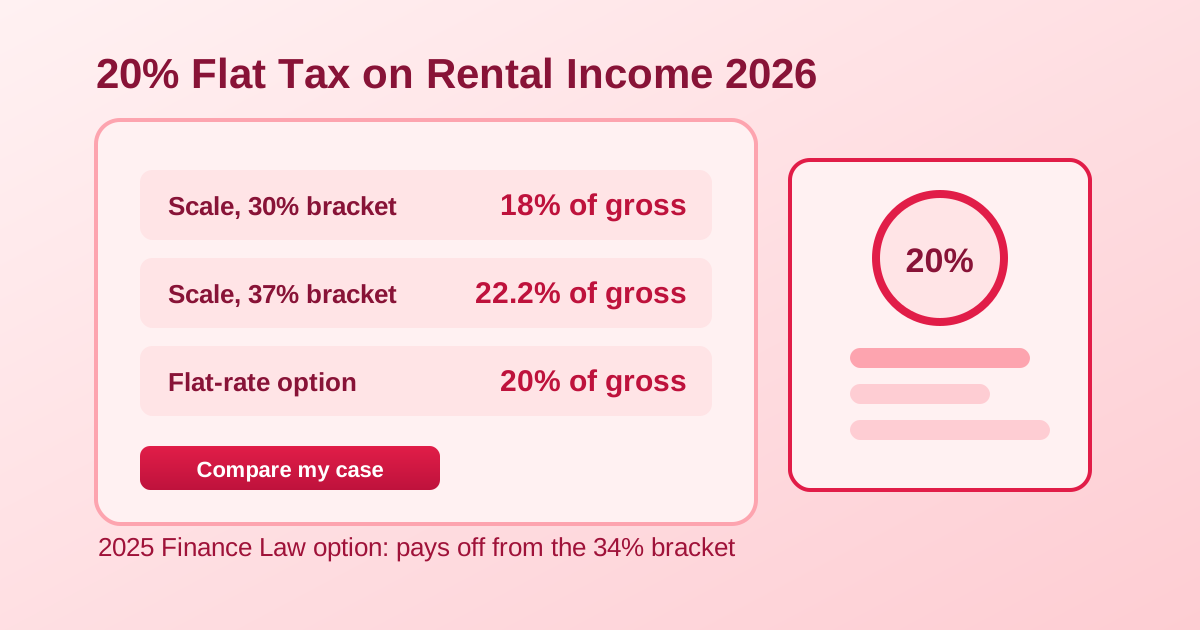
The default regime for rental income applies a flat 40% allowance on gross rent collected. For an apartment let at 7,500 MAD per month, so 90,000 MAD across the year, the taxable base drops to 54,000 MAD. The progressive income tax scale then applies bracket by bracket: 0% up to 40,000 MAD, 10% from 40,001 to 60,000 MAD, 20% from 60,001 to 80,000 MAD, 30% from 80,001 to 100,000 MAD, 34% from 100,001 to 180,000 MAD, and 37% above that. On a 54,000 MAD base, only the 14,000 MAD slice sits above the 40,000 MAD threshold, so the tax comes to 1,400 MAD for the year. A useful reminder: even small rents must appear on the annual return, filed before 1 March, including when the final tax is nil.
The actual-expenses regime replaces that allowance with a deduction of costs genuinely incurred and documented. Deductible items include loan interest on the mortgage tied to the property, the municipal services tax, insurance premiums (multi-risk home cover, unpaid-rent guarantee), letting management fees paid to an agency, building management charges, and maintenance or repair works. Construction, extension and additional-storey works do not qualify as expenses of the year. They add to the cost basis and only come into play at resale. Each item needs a named invoice or the bank's amortization schedule as backing.
Take that same property at 90,000 MAD of annual rent with 28,000 MAD of real charges: 12,000 MAD of loan interest, 4,410 MAD of municipal services tax, 2,500 MAD of insurance, 5,400 MAD of management fees (6% of rent) and 3,690 MAD of building charges. Under the actual regime the taxable base is 62,000 MAD and tax reaches 2,400 MAD (2,000 MAD in the 10% bracket, 400 MAD on the slice taxed at 20%). The flat-rate regime caps the bill at 1,400 MAD. At this level of charges the flat-rate option wins, and it wins by 1,000 MAD.
The tipping point is easy to remember: the actual regime only pays off once documented charges exceed 40% of rent, meaning 36,000 MAD in this example. Change one assumption and the ranking flips. Add 18,000 MAD of refurbishment (plumbing, waterproofing, joinery) and charges climb to 46,000 MAD: the base falls to 44,000 MAD and tax to just 400 MAD, against 1,400 MAD under the flat rate. This pattern shows up often in the early years of a mortgage, when interest is high, and in any year with heavy works. Run both scenarios in the rental tax calculator before locking your choice, then feed the result into the ROI simulator. The allowance mechanics are covered in our dedicated guide.
Municipal services tax and housing tax on a let property
These two local taxes are routinely mixed up even though they hit different people. Housing tax targets the owner who occupies the home, or an occupant living there free of charge. As soon as the property is let, it stops being due on that unit. What remains is the municipal services tax, which stays with the landlord. Its base is the annual rental value set by the tax administration, revised upward by 2% every five years. The rate is 10.5% of that rental value inside urban communes and designated centres, and 6.5% in peripheral zones.
A worked figure makes the real weight visible. For a Casablanca apartment whose administrative rental value is set at 42,000 MAD per year, the municipal services tax comes to 4,410 MAD annually, or 367 MAD per month. On a rent of 7,500 MAD per month, that single line absorbs close to 5% of collections. The tax is owed by the landlord for the full year even if the unit sat empty for several months. It never reduces the rent you declare: the gross income reported on the return is the rent actually received, with nothing netted off.
Deductibility depends entirely on the regime you pick. Under the flat rate, the 40% allowance is deemed to cover the landlord's costs as a whole, so the municipal services tax cannot be deducted a second time. Under the actual-expenses regime, the 4,410 MAD comes straight off the taxable base. For a landlord sitting in the 20% marginal bracket, that is 882 MAD of tax saved for the year. Across a portfolio of three comparable apartments, the annual saving approaches 2,650 MAD.
In practice, ask for your assessment notice every year and check the rental value used. A value inflated against rents actually achieved in the neighbourhood can be challenged with the assessment office. Remember to put those 4,410 MAD into the charges line of the ROI simulator: a net yield calculated without this tax is overstated by 0.3 to 0.5 of a point on an entry-level property. For the full mechanics of rental income taxation, see our rental income tax guide.
The landlord's compliance calendar, month by month
January and February are for gathering paperwork. Collect the twelve signed rent receipts, the registered lease, works invoices and the municipal services tax notices. One detail many owners discover too late: the 4% registration duty and the 1.5% land registry fee paid at purchase are not deductible against rental income. On a 1,200,000 MAD acquisition, those 48,000 MAD and 18,000 MAD add to the cost basis and only matter when capital gains are computed at resale.
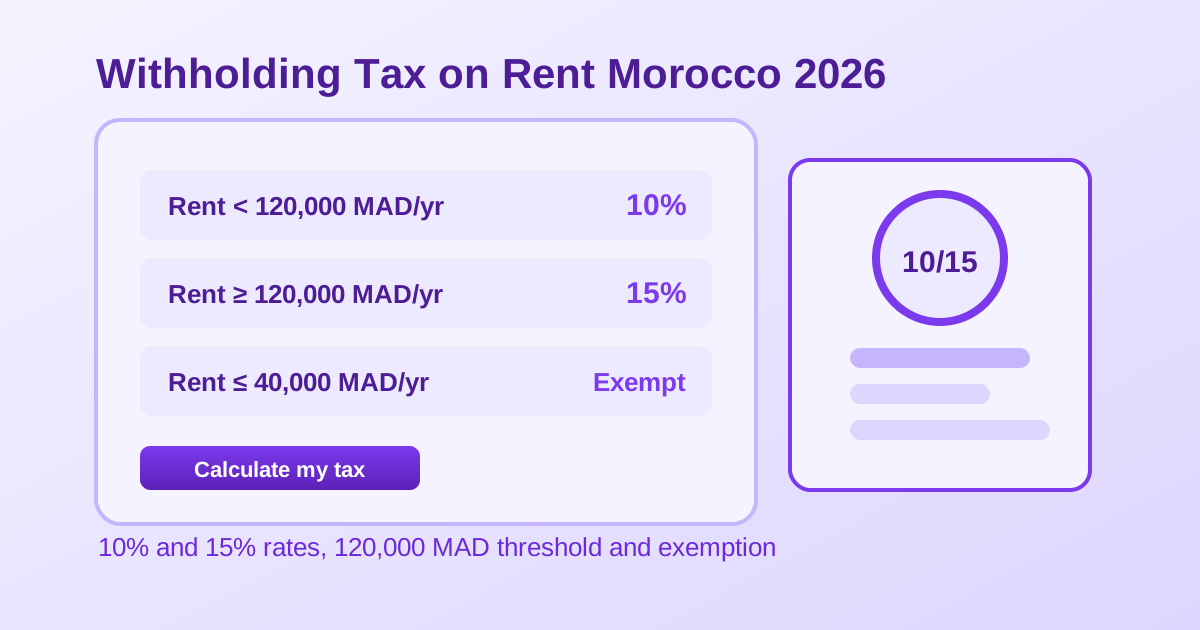
If your tenant is a legal entity (company, association, public body) or a professional taxed under the actual or simplified net result regime, they must withhold tax at source on the rent. The rate is 10% while gross annual rent stays below 120,000 MAD, and 15% once it reaches or passes that threshold. An office floor let at 11,000 MAD per month means 132,000 MAD over the year, so 19,800 MAD withheld and 112,200 MAD actually banked. Ask for the withholding certificate before the end of January: without that document you cannot credit the 19,800 MAD already taken against your final tax bill, and you end up paying twice. The thresholds are broken down in our rent withholding guide.
The annual rental income return must be filed before 1 March on Simpl-IR, the tax administration's online service. You report gross rent collected per property, the regime chosen for the year, itemized charges if you go with the actual regime, and any tax already withheld at source. Payment follows electronically in the same session. The regime choice is made at that exact moment and binds you for the year concerned, so the simulation belongs before you submit, not after. The step-by-step procedure is in our filing guide.
The cost of being late is mechanical. Filing within thirty days of the deadline triggers a 5% surcharge. Past thirty days it rises to 15%. Where the administration assesses you on its own after an unanswered formal notice, it reaches 20%. On top come a 10% collection penalty on the principal and 0.5% for each additional month of delay. On 12,000 MAD of rental income tax filed four months late, the 15% surcharge is 1,800 MAD, the collection penalty 1,200 MAD and late interest roughly 240 MAD, pushing the bill past 15,200 MAD. Set a reminder for 15 February and size the provision to set aside with the rental tax calculator.
Quick FAQ
- Should I decide from pre-tax or post-tax return? Decide from post-tax.
- Does higher tax always kill the deal? No, strong entry price and disciplined management can keep the deal viable.
- How do I stay conservative? Use low/high ranges instead of one point estimate.
- What should I do first? Build a baseline in our ROI calculator.
References
Use our Morocco rental profitability calculator
Gratuit · Résultats en 2 minutes