Two models with different risk profiles
In Morocco, comparing Airbnb with long-term rental is not just a gross-income exercise. Each model has a different cost structure, vacancy pattern, and management workload.
The goal is to choose the model with the strongest real ROI after costs and execution complexity, not the one with the highest headline revenue.
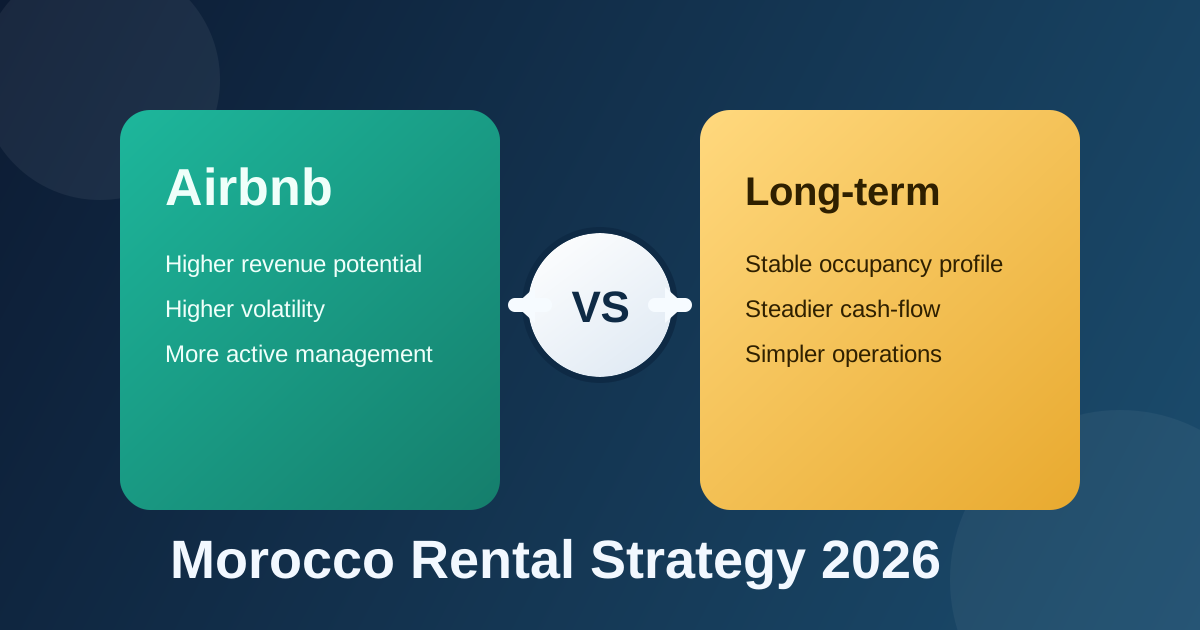
Long-term rental: stability and simpler operations
Long-term rental usually offers more predictable cash flow, lower day-to-day overhead, and easier budgeting. This can be especially valuable when debt service is fixed every month.
The tradeoff is often a lower revenue ceiling versus short-term in high-demand pockets. But lower volatility can improve net performance consistency.
Start with a prudent baseline in our ROI calculator: realistic rent, vacancy allowance, and full recurring costs.
Airbnb: upside potential with heavier execution demands
Short-term rental can produce higher gross income in tourism and business zones, but it adds sensitivity to occupancy, seasonality, platform fees, cleaning, and active management.
Without strong operations, annual net income can underperform expectations even when high-season months look impressive.
Before choosing Airbnb, model both high and low season cases in the calculator.
The only fair comparison: net income after operating costs
The right comparison is annual net income after costs. For long-term, costs are typically more stable. For Airbnb, include variable costs per booking and realistic occupancy.
A 10-point occupancy difference can materially change annual ROI, especially when financing is involved.
You can estimate top-line short-term revenue with our Airbnb income estimator, then validate full ROI in the main tool.
Financing pressure can change the winner
With a mortgage, monthly debt service is a hard constraint. Models with volatile monthly income need larger liquidity buffers.
Long-term rental is often easier for consistent debt coverage. Airbnb may still outperform, but only if occupancy and operations remain disciplined.
Use the mortgage payment guide and then test both strategies in the ROI simulator.
A 4-step decision method
- Build a conservative long-term scenario. 2) Build a conservative Airbnb scenario with full operating costs. 3) Compare net income and management effort. 4) Keep only the model that remains acceptable under downside assumptions.
This process avoids decisions based on peak months and produces a repeatable investment framework.
You can run these steps directly in our Morocco rental ROI calculator.
Fast pre-decision checklist
Checklist
- Validate real rent levels or realistic nightly rates.
- Include vacancy and seasonality conservatively.
- Include all costs (management, cleaning, maintenance, taxes).
- Check debt coverage in weak months.
- Compare net return against required time/effort.
The best model is the one that is profitable and executable for your context.
Worked case: a 1,000,000 MAD apartment in Casablanca
Take one single property so the comparison stays honest: a 75 sqm two-bedroom apartment in a central Casablanca district, bought at 1,000,000 MAD. The real entry cost is not 1,000,000 MAD. Add registration duties at 4% (40,000 MAD) and land registry fees at 1.5% (15,000 MAD). Every calculation below uses an investment base of 1,055,000 MAD, notary fees excluded to keep the arithmetic readable.
Long-term scenario. Market rent is 7,500 MAD per month, so 90,000 MAD per year, a gross yield of 8.5% on 1,055,000 MAD. Annual running costs: 5% vacancy allowance (4,500 MAD), building service charges at 400 MAD per month (4,800 MAD), municipal services tax and housing tax (1,800 MAD), landlord insurance (1,200 MAD), maintenance and small repairs (3,000 MAD). Total: 15,300 MAD. Net income before tax lands at 74,700 MAD per year, a net yield of 7.08%.
Airbnb scenario. The same apartment, furnished and let at 550 MAD per night. At 60% occupancy that is 219 nights and 120,450 MAD of revenue. At 70% it is 256 nights and 140,800 MAD. Variable costs (concierge service, cleaning, platform commissions, laundry) run at 20 to 25% of revenue. Fixed costs are heavier than in long-term rental because the host pays water, electricity and internet: service charges 4,800 MAD, local taxes 1,800 MAD, furnished-property insurance 1,800 MAD, utilities and connectivity 9,600 MAD, maintenance and furniture replacement 6,000 MAD, so 24,000 MAD per year.
Side by side. At 60% occupancy with 25% variable costs: 120,450 MAD minus 30,113 MAD minus 24,000 MAD = 66,337 MAD net, or 6.29%. At 70% occupancy with 20% variable costs: 140,800 MAD minus 28,160 MAD minus 24,000 MAD = 88,640 MAD net, or 8.40%. Against the 74,700 MAD of the long-term lease the verdict is plain: below the occupancy threshold the classic lease wins; above it, Airbnb pulls ahead by as much as 14,000 MAD a year.
The break-even occupancy rate is 63%, meaning 232 nights a year, using a mid-case assumption of 22.5% variable costs. That threshold moves with your cost structure: 61% if you hold variable costs at 20%, 66% if they climb to 25%. One detail most investors forget: the initial furnishing package costs roughly 80,000 MAD. Amortised over five years it adds 16,000 MAD of annual cost and pushes break-even to around 74% occupancy for those first five years. Run your own numbers in the rental yield simulator and your average nightly rate in the Airbnb income estimator, cross-checked against the city-by-city data.
Tax comparison: property income versus professional income
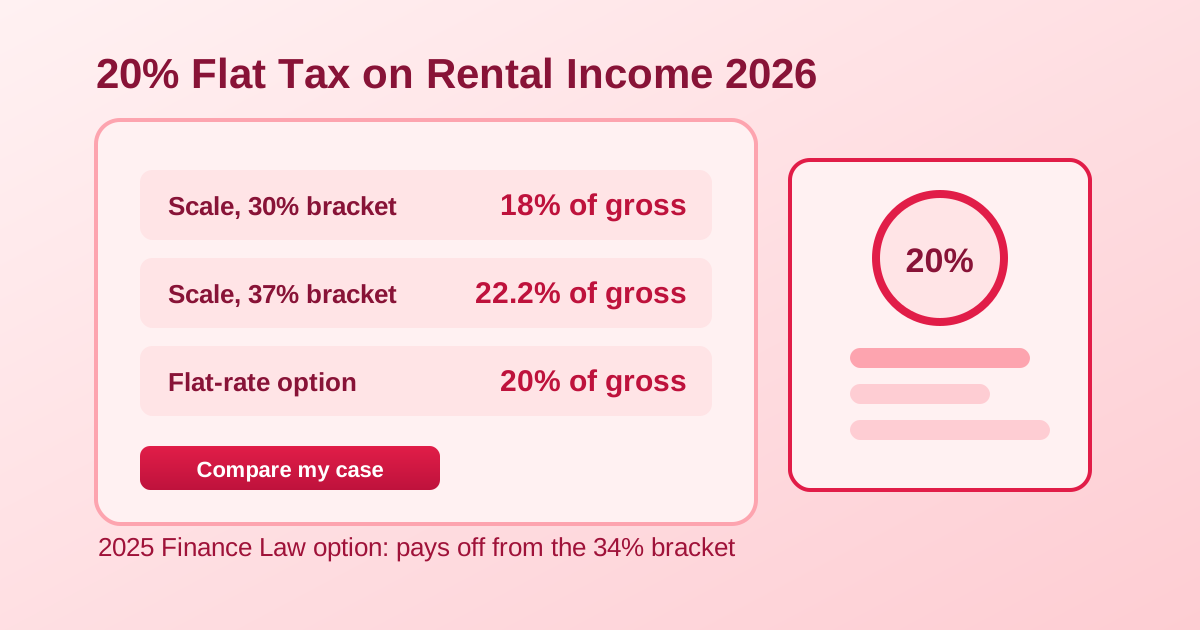
The two models do not sit in the same tax category, and this is where many investors get it wrong. Long-term residential letting falls under property income (revenus fonciers). That income is exempt as long as it stays below 30,000 MAD per year. Above that, a flat 40% allowance applies, then the progressive income tax scale.
Back to our 90,000 MAD of annual rent. After the 40% allowance the taxable base drops to 54,000 MAD. The 2026 income tax scale reads: 0% up to 40,000 MAD, 10% from 40,001 to 60,000, 20% from 60,001 to 80,000, 30% from 80,001 to 100,000, 34% from 100,001 to 180,000. On 54,000 MAD: nothing on the first band, then 10% on 14,000 MAD. Tax due is 1,400 MAD, an effective rate of 1.56% of gross rent. Net after tax moves from 74,700 to 73,300 MAD.
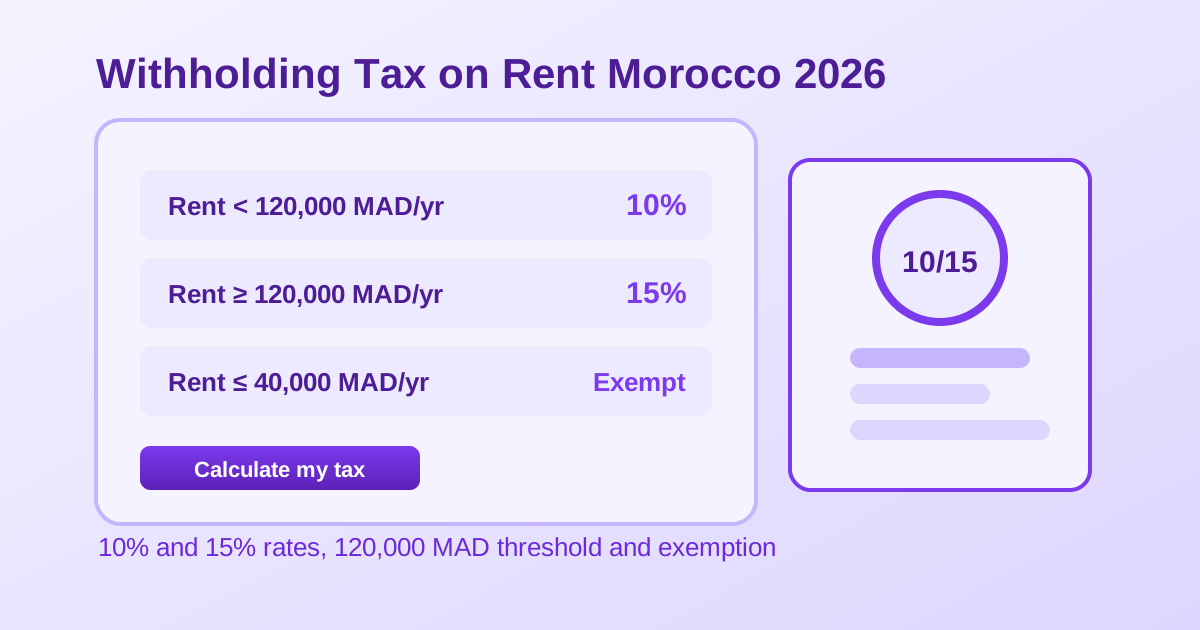
The return must be filed before 1 March on the Simpl-IR portal. Watch the withholding tax: when the tenant is a legal entity or a professional taxed under the RNR or RNS regime, they withhold 10% if your rental income stays below 120,000 MAD per year, and 15% from that threshold upward. On 90,000 MAD that is 9,000 MAD withheld while you only owe 1,400 MAD, so 7,600 MAD have to be reclaimed, and the only route is the annual return. Band detail sits in our rental withholding tax scale, and the full calculation in the 2026 rental income tax guide.
Short-term furnished tourist rental changes category: it is treated as a professional activity. Neither the 40% allowance nor the 30,000 MAD exemption applies. With 120,450 MAD of revenue you stay well under the 500,000 MAD services ceiling, which opens the unified professional contribution (CPU): tax is 10% applied to a base equal to revenue multiplied by the activity margin coefficient set in the tax code. With a 20% coefficient the base is 24,090 MAD and income tax lands near 2,409 MAD, plus complementary duties running from a few hundred to a little over 1,000 MAD. Budget around 3,400 MAD in total. The simplified net result regime (RNS) stays the alternative if you exceed the ceilings or want to deduct furniture depreciation.
Two obligations are specific to short-term letting. The tourist stay tax is collected from the guest, usually 10 to 30 MAD per person per night depending on the commune and the classification. On 219 nights with two guests at 10 MAD that is 4,380 MAD a year to collect and remit: if you do not build it into your displayed rate it comes straight out of your margin. You also need a commercial register entry and a tax identifier. The practical outcome: after tax, long-term letting returns 73,300 MAD, against roughly 62,900 MAD for Airbnb at 60% occupancy and 84,600 MAD at 70%. Tax widens the gap when occupancy is weak, but it does not reverse the Airbnb advantage when occupancy is strong.
Which investor profile fits which model
The passive investor. If you want to bank a rent and stop thinking about it, long-term letting has no competitor. Those 74,700 MAD net take a few hours a year: one lease, a monthly receipt, a February filing. The Airbnb scenario at 60% occupancy means roughly 220 check-ins and check-outs, 219 cleanings to coordinate and a daily inbox to run. If you value your time at 150 MAD an hour and spend 200 hours a year on it, that is 30,000 MAD of implicit labour, well above the income gap between the two models.
The active investor and the remotely managed MRE. A Moroccan living abroad cannot run the operation personally, so a concierge company takes over. All-in fees run between 20 and 25% of revenue in Casablanca, sometimes 30% in Marrakech once cleaning and linen are included. At a 30% commission you need 70% occupancy just to match the long-term lease. An MRE who picks the classic lease with a corporate tenant faces the 10% withholding, so the return must be filed before 1 March in any case to recover the overpayment.
Seasonality. Casablanca is a business market: occupancy is flat, between 55 and 65% across the year, weekday-heavy, with a stable average nightly rate. Marrakech and Agadir climb above 75% in high season and fall below 40% in the dead months. The 63% threshold is far easier to clear in Marrakech than in Casablanca, and that is exactly why the same calculation gives opposite answers depending on the city. Compare rent levels and price per sqm in the city-by-city data.
Three numeric thresholds that should tip the decision. First threshold: if your realistic average annual occupancy stays below 63% (232 nights), take the long-term lease; below 55%, the gap exceeds 15,000 MAD a year in favour of the classic lease. Second threshold: if the concierge company asks for more than 28% all-in commission, break-even climbs to 68% occupancy, a level rarely sustainable outside Marrakech and Agadir. Third threshold: if the achievable long-term rent exceeds 8,500 MAD per month (102,000 MAD per year), Airbnb has to hold 71% occupancy just to draw level, and the classic lease becomes the default choice.
These thresholds are reference points, not universal truths: they depend on your purchase price, your district and your real cost structure. Rebuild them with your own figures in the rental yield simulator and the Airbnb income estimator. The results shown here are indicative and should be validated by a chartered accountant or your local tax office before you commit.
Quick FAQ and references
- Is Airbnb always more profitable? No. It depends on occupancy quality, fees, and operational discipline.
- Which model is usually more stable? Long-term rental.
- Can I start long-term then switch? Often yes, if the area and compliance constraints allow it.
- How should I decide? Compare two conservative scenarios in the ROI calculator.
Useful references
Use our Morocco rental profitability calculator
Gratuit · Résultats en 2 minutes