The rent withholding scale in force in 2026
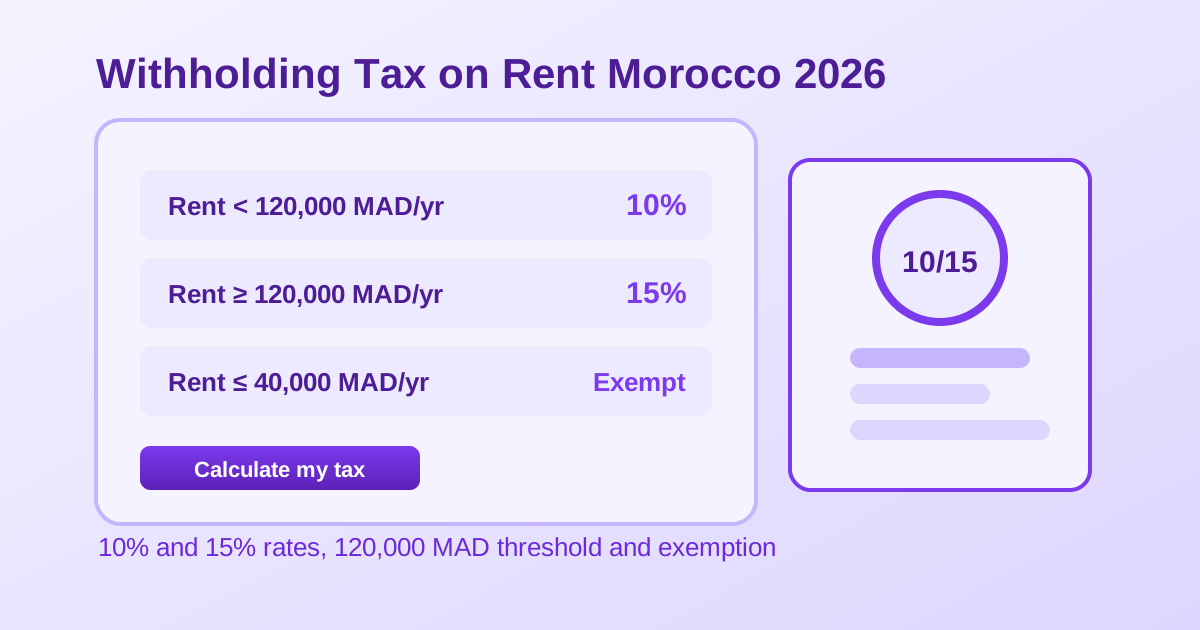
The withholding tax (RAS) scale on rents applicable in 2026 has two rates: 10% when the gross taxable amount of annual rent paid to the owner is below 120,000 MAD, and 15% when it is equal to or above 120,000 MAD. The mechanism was introduced by the 2023 Finance Law and remains in force in 2026: the withholding obligation sits in articles 160 bis and 173 of the Moroccan General Tax Code (CGI), the rates in article 73-II.
Withholding only applies to rent paid by legal entities (companies, public bodies, associations) or professional individuals taxed under the actual net income regime (RNR) or simplified regime (RNS). If your tenant is a private individual, no RAS applies: you fall under the standard regime described in our rental income tax guide.
The 2026 scale: thresholds, rates and the exemption
| Gross taxable annual rent | 2026 RAS rate | Concrete example |
|---|---|---|
| Up to 40,000 MAD | No withholding | 3,000 MAD/month: 0 MAD withheld |
| 40,001 to 119,999 MAD | 10% | 8,000 MAD/month: 800 MAD withheld |
| 120,000 MAD and above | 15% | 12,000 MAD/month: 1,800 MAD withheld |
The gross taxable amount means rent before any deduction. Key point: the rate applies to the entire rent, not only to the portion above the threshold. Annual rent of 120,000 MAD is withheld at 15% on the whole amount, 18,000 MAD, while rent of 118,800 MAD (9,900 MAD/month) is withheld at 10%, 11,880 MAD. The threshold effect is real and should be anticipated in your cash-flow planning.
The exemption up to 40,000 MAD means the tenant does not have to withhold when annual gross rent paid to the same owner stays at or under that amount. The threshold was 30,000 MAD until 2024: the 2025 Finance Law raised it to 40,000 MAD for rent collected from 1 January 2025 (article 160 bis of the CGI). It does not remove the owner's annual filing duty: see our rental income filing guide.
Who withholds, and when the money is due
The party liable for withholding is the tenant, never the owner. Required to withhold: public or private legal entities, and professional individuals whose business income is taxed under the RNR or RNS regime, whenever they pay rent to individuals. A private tenant, an auto-entrepreneur or a professional under the single professional contribution regime withholds nothing.
The amount withheld must be paid to the tax administration before the end of the month following the rent payment. The tenant then gives the owner a withholding certificate summarising amounts withheld and paid. Insist on this document: it substantiates your tax credit in the annual return. Failure to remit exposes the tenant, not the owner, to surcharges and penalties.
Step-by-step calculation: three rents, three outcomes
Rent of 7,500 MAD/month (90,000 MAD/year, below the 120,000 threshold): 10% rate. Monthly withholding = 750 MAD, the owner receives 6,750 MAD. Annual RAS = 9,000 MAD.
Rent of 10,000 MAD/month (120,000 MAD/year, threshold reached): 15% on the full amount. Monthly withholding = 1,500 MAD, the owner receives 8,500 MAD. Annual RAS = 18,000 MAD. Compare with rent of 9,900 MAD/month: 118,800 MAD/year, 10% rate, 11,880 MAD withheld annually. The extra 1,200 MAD of annual rent triggers 6,120 MAD of additional withholding, recoverable only at year-end settlement.
Rent of 20,000 MAD/month (240,000 MAD/year): 15% rate. Monthly withholding = 3,000 MAD, net receipt of 17,000 MAD, annual RAS = 36,000 MAD. To measure the impact on your net yield, enter the rent actually received in the rental yield simulator.
An advance on income tax, not a final tax: the annual settlement
The 10% or 15% RAS is not final: it is an advance on your income tax. Each year, before 1 March, you file your global income return on Simpl-IR. Your actual rental income tax is then computed on gross rent after the 40% flat deduction, taxed at the progressive scale. Withholdings already made are credited against it.
Example with 120,000 MAD of annual rent: taxable base = 120,000 × 60% = 72,000 MAD. Income tax under the scale: 0 MAD up to 40,000, 2,000 MAD on the 40,000 to 60,000 bracket (10%), 2,400 MAD on the remaining 12,000 MAD (20%), so 4,400 MAD of actual tax. RAS paid: 18,000 MAD. The surplus of 13,600 MAD is refundable or creditable. Skipping the return means leaving that money with the Treasury. Run your own numbers in the rental tax calculator.
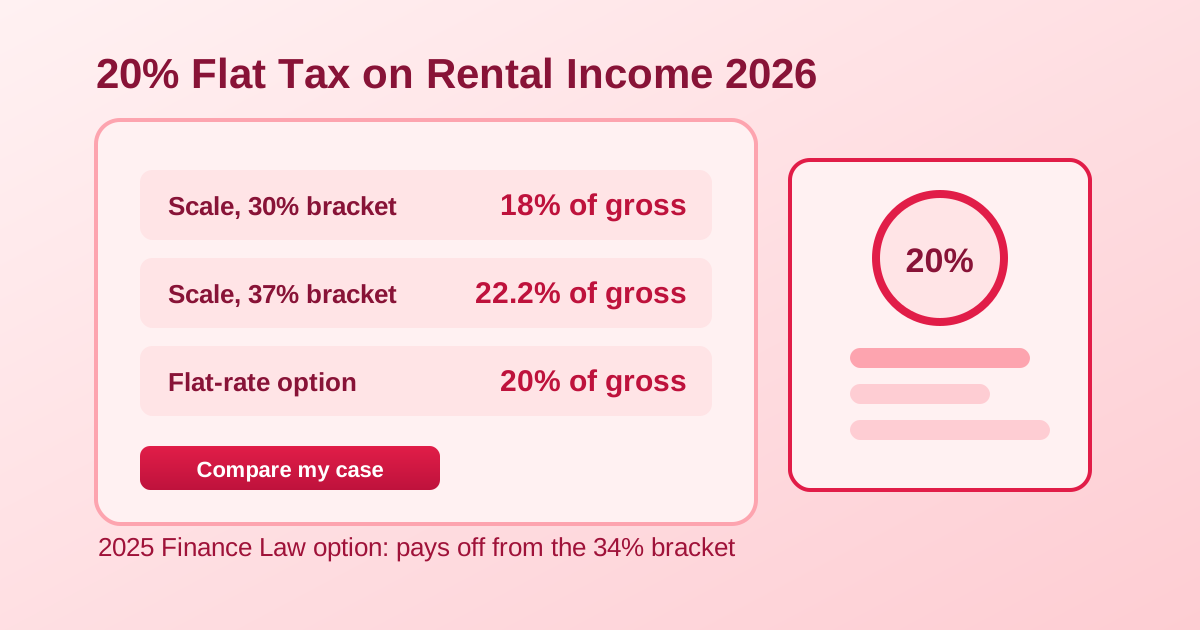
Since 2025, a third route: the final 20% withholding. Article 64-IV of the CGI, added by the 2025 Finance Law, lets you opt for a 20% withholding on gross rent, with no 40% deduction and no 40,000 MAD threshold. That withholding settles the tax: no year-end adjustment and no return for those rents. On the example above it would cost 24,000 MAD against 4,400 MAD under the scale for an owner with no other income. It only pays off when your other income already puts you in the 34% or 37% brackets. The break-even calculation is in our 20% flat-rate option guide.
Casablanca case study: office let to an SARL at 15,000 MAD/month
An owner lets an office floor in Maarif to an SARL for 15,000 MAD/month, 180,000 MAD/year. The 120,000 MAD threshold is exceeded: the SARL applies 15%. Each month it pays 12,750 MAD to the owner and 2,250 MAD to the Treasury. Annual RAS: 27,000 MAD.
Settlement: taxable base = 180,000 × 60% = 108,000 MAD. Tax under the progressive scale: 2,000 + 4,000 + 6,000 + 2,720 (34% on the 8,000 MAD above 100,000) = 14,720 MAD. The refundable RAS surplus reaches 12,280 MAD. The final effective rate is about 8.2% of gross rent. For monthly cash flow, 12,750 MAD (not 15,000) is the figure to enter in your profitability simulation, since the refund only arrives after the return is processed.
Common mistakes and points of attention
Applying 10% instead of 15%: the 120,000 MAD threshold is assessed on the annual total paid to the same owner. A tenant renting two premises at 70,000 MAD each from the same landlord crosses the threshold and must withhold 15% on everything. Treating the RAS as final: the annual return remains mandatory, and it is often what triggers a refund in your favour. Forgetting to claim the surplus: crediting or refunding never happens automatically without a return.
Misreading the 40,000 MAD exemption: it spares the tenant from withholding, but the owner's income tax exemption follows its own rules (see our rental tax guide). Finally, keep every withholding certificate: without it the administration can deny the tax credit. Figures in this guide are indicative: have your situation validated by a tax advisor or your local tax office.
Official sources and related guides
The RAS scale is set by the CGI and updated by each annual Finance Law. Check the texts in force before any decision: the consolidated CGI is published by the DGI.
Useful sources
Frequently asked questions
- Does the 15% rate apply to the whole rent or only above 120,000 MAD?
- To the entire gross annual amount. The RAS scale is not progressive by brackets: once annual rent reaches 120,000 MAD, the 15% applies to everything.
- My tenant is a private individual, what RAS rate applies?
- None. Withholding only concerns tenants that are legal entities or professionals under the RNR/RNS regimes. With a private tenant, you declare rental income under the standard regime.
- Is the 10% or 15% RAS my final tax?
- No. It is an advance credited against your income tax computed after the 40% deduction and the progressive scale. If the withholding exceeds the actual tax, the surplus is refundable through the annual return.
- What happens if annual rent does not exceed 40,000 MAD?
- The tenant is exempt from withholding. The owner must still file the annual global income return before 1 March.
- When must the tenant remit the withheld amount?
- Before the end of the month following the rent payment, to the tax collector the tenant reports to.
Use our Morocco rental profitability calculator
Gratuit · Résultats en 2 minutes