The 40% deduction: the tax relief every landlord in Morocco must understand
When you receive rental income in Morocco, you do not pay personal income tax (IR) on the full amount collected. Moroccan law grants landlords a flat-rate deduction of 40% on gross rental income. This means that only 60% of your rents form the taxable base to which the progressive IR brackets apply. This is the first (and most important) step in any rental tax calculation in Morocco.
The deduction is automatic and standardised: you do not need to justify actual expenses or submit supporting documents. It is designed to cover all ownership and letting costs in aggregate. Understanding exactly how it works lets you build a precise tax provision into your rental ROI simulation and avoid unpleasant surprises at declaration time.
How the deduction works: calculating your taxable base
The calculation is straightforward. Step 1: add up all gross rents received during the year (total before any deduction). Step 2: multiply that total by 60% to get the taxable base, the 40% deduction is automatically removed. Step 3: apply the progressive IR scale to this taxable base. If the taxable base falls below 40,000 MAD, the rate is 0% and no tax is owed (even if you have exceeded the gross exemption threshold of 30,000 MAD).
Simple example: you receive 5,000 MAD/month in rent, giving 60,000 MAD gross for the year. Taxable base: 60,000 × 60% = 36,000 MAD. This is below the first taxable bracket of 40,000 MAD, so your IR is 0 MAD. You are above the 30,000 MAD gross threshold and must file a declaration, but you owe nothing. The deduction makes all the difference here. Test your own figures in our ROI calculator by adding your IR provision to monthly expenses.
What the 40% deduction is supposed to cover
The 40% flat deduction is designed to represent all ownership and letting costs in a single allowance. It covers: maintenance and repairs (plumbing, electrical, painting, minor works), co-ownership charges (syndic fees), insurance (home multi-risk, rent guarantee), property management fees (letting agent or property manager), and a portion of the property's economic depreciation.
What is not covered within the flat-rate regime: mortgage interest. In the flat-rate regime, these are not separately deductible, the 40% deduction is supposed to include everything. This is a crucial point for investors who financed the purchase with a mortgage: if your interest charges plus actual running costs exceed 40% of gross rents, the actual-expenses regime may be more beneficial, although it requires formal bookkeeping. For the vast majority of individual landlords with one or two properties, the flat-rate regime remains simpler and typically sufficient.
The 30,000 MAD exemption threshold and how it interacts with the deduction
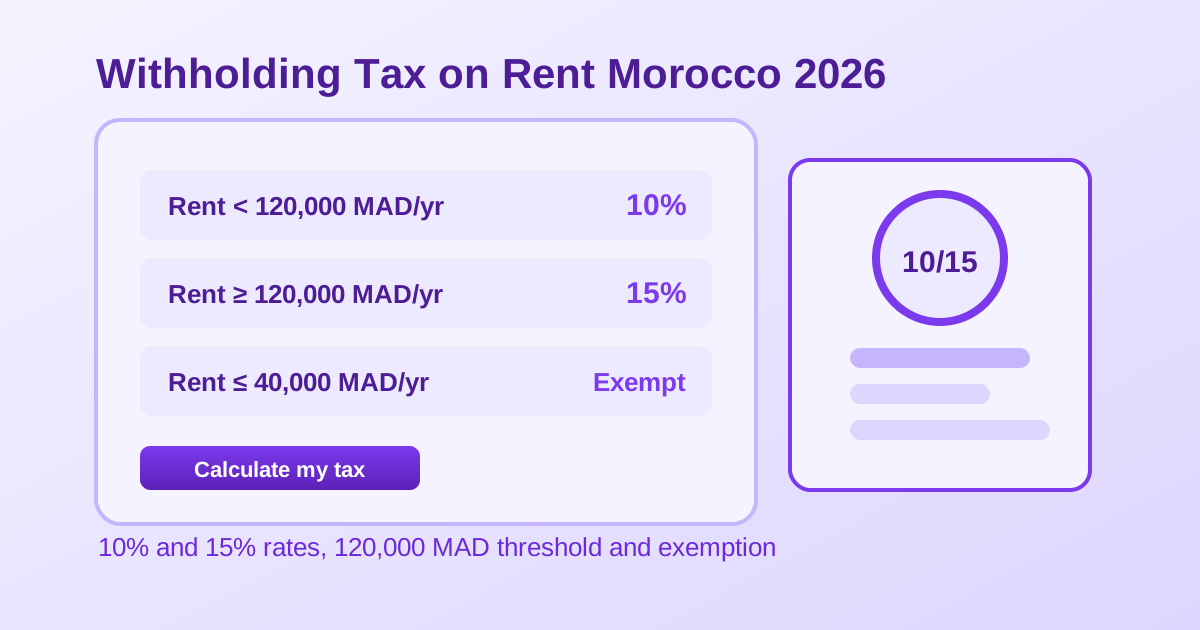
The 30,000 MAD gross annual threshold is the first filter: below it, no IR is due on that rental income. The annual return is required in every case, even under this threshold. But the 40% deduction then applies to compute the actual taxable base.
The subtlety: even if you exceed 30,000 MAD gross, your taxable base after the 40% deduction can still fall below the first taxable bracket of the IR scale (40,000 MAD), meaning you pay 0 MAD in IR. This applies to all landlords whose gross annual rents are between 30,000 MAD and 66,667 MAD (up to ~5,555 MAD/month): they must file but owe nothing, thanks to the deduction plus the zero-rate first bracket. This detail is frequently misunderstood and leads to systematic overestimates of the tax burden.
Step-by-step examples: three landlord profiles in 2026
Profile 1, Rent 4,000 MAD/month (48,000 MAD/year gross): Taxable base = 48,000 × 60% = 28,800 MAD. IR scale: 0% on 28,800 MAD (below the 40,000 MAD bracket). IR = 0 MAD. You file but owe nothing. Effective rate on gross: 0%.
Profile 2, Rent 8,000 MAD/month (96,000 MAD/year gross): Taxable base = 96,000 × 60% = 57,600 MAD. IR scale: 0% on 40,000 MAD = 0 MAD. 10% on 17,600 MAD = 1,760 MAD. Total IR = 1,760 MAD/year (≈ 147 MAD/month). Effective rate on gross: 1.83%. Add 147 MAD/month as a tax provision in your ROI calculation.
Profile 3, Rent 15,000 MAD/month (180,000 MAD/year gross): Taxable base = 180,000 × 60% = 108,000 MAD. Progressive scale: 0 MAD (40,000) + 2,000 MAD (20,000 at 10%) + 4,000 MAD (20,000 at 20%) + 6,000 MAD (20,000 at 30%) + 2,720 MAD (8,000 at 34%) = total IR 14,720 MAD/year (≈ 1,227 MAD/month). Effective rate on gross: 8.2%. At this income level, IR is a significant cost to budget for from day one.
Flat-rate vs actual-expenses regime: when to switch
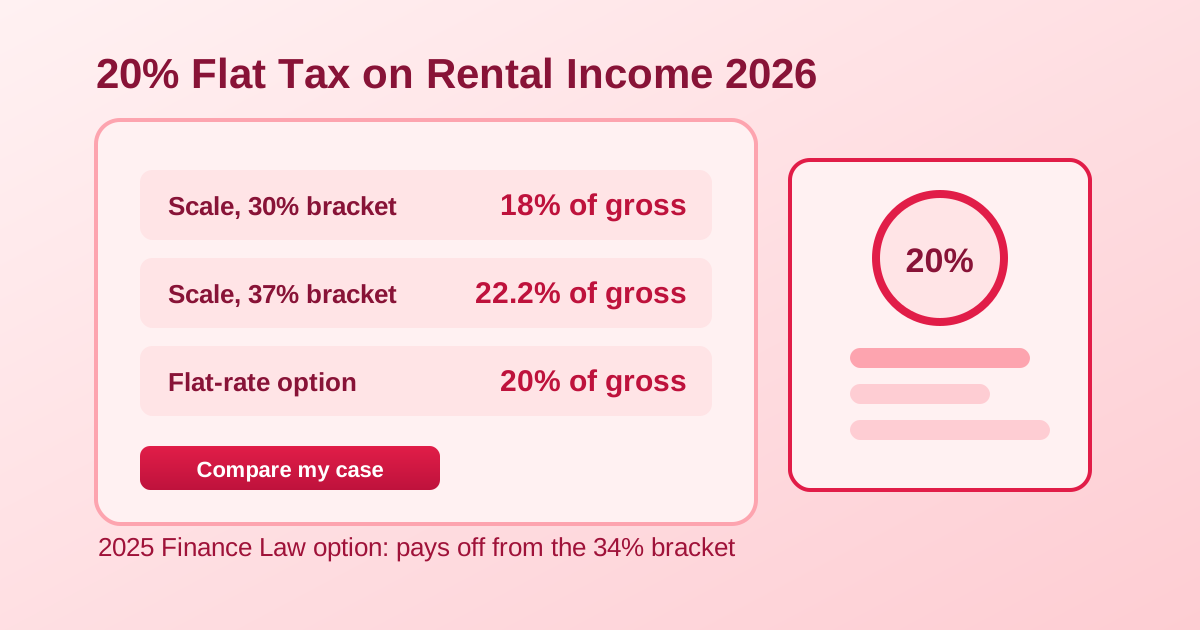
The flat-rate regime (40% deduction) is the default for unfurnished residential lettings. It is simple: no bookkeeping required, no expense receipts to submit. It is optimal when actual costs are below 40% of gross rents, the situation for most landlords with unencumbered or nearly paid-off properties.
The actual-expenses regime becomes relevant if your real costs exceed 40% of gross rents, particularly early in a mortgage or after major renovation works. Under this regime you deduct documented actual charges (mortgage interest, maintenance, management, insurance, depreciation) instead of the flat deduction. The IR saving can be substantial in the first years of a high-value mortgage. The trade-off: formal bookkeeping is mandatory, declarations are more complex, and you must operate under a professional tax regime. A tax adviser can model both regimes over 5–10 years given your income level and cost structure.
How to file on Simpl-IR: a practical step-by-step
Rental income declarations are submitted through the Simpl-IR portal of the Direction Generale des Impots at tax.gov.ma. The deadline is typically 1 March of the year following the tax year (e.g. 2025 income must be filed by 1 March 2026). Paper filing at your local tax office is also accepted.
Practical steps: (1) Log in to your Simpl-IR account using your tax identification number (IF). (2) Select the rental income declaration for the relevant year. (3) Enter the gross annual rent for each property. (4) The system automatically calculates the 40% deduction and the taxable base. (5) Review the taxable base and the IR amount shown. (6) Confirm and pay any amount due (bank transfer or in person). If you are below the threshold or if the calculated IR is zero, still confirm the declaration, it protects your tax position. Documents to prepare: rent receipts or bank transfer statements, copies of registered lease agreements.
Multiple properties: how cumulative rents affect your taxable base
If you own several rental properties, the gross rents from all properties are aggregated to calculate the combined taxable base. The 40% deduction applies to the consolidated total, and the progressive IR scale is then applied to the combined taxable base. This means that adding a property can push your total income into a higher bracket.
Example: two apartments generating 5,500 MAD/month and 6,000 MAD/month respectively. Total gross annual income: (5,500 + 6,000) × 12 = 138,000 MAD. Taxable base: 138,000 × 60% = 82,800 MAD. IR: 0 MAD (40,000) + 2,000 MAD (20,000 at 10%) + 4,000 MAD (20,000 at 20%) + 840 MAD (2,800 at 30%) = 6,840 MAD/year (570 MAD/month). Tax law requires consolidation, never calculate each property's tax in isolation. Model your full portfolio on a consolidated basis in our rental ROI simulator.
Building the tax deduction into your rental ROI calculation
The simplest way to incorporate IR into your ROI calculator is to estimate your annual IR after the deduction (see examples above), divide by 12 and add it to your monthly expenses field. Your net monthly cash flow and cash-on-cash ROI will then reflect the true after-tax reality.
Quick reference: if your monthly rent is below 5,500 MAD, your IR is likely zero (deduction + zero first bracket). Between 6,000 and 10,000 MAD/month, budget between 100 and 500 MAD/month for IR. Above 12,000 MAD/month or with multiple properties, a precise calculation becomes essential and IR can materially reduce ROI. Never leave tax out of your initial simulation, it is a real cost of your investment, not an afterthought.
FAQ + resources on the 40% deduction for rental income in Morocco 2026
- Does the 40% deduction apply to furnished lettings? For furnished lettings operated on a regular basis, the regime may shift to professional income, where the 40% deduction does not apply in the same way. Rules differ depending on the nature and frequency of the letting.
- Can I stack the deduction with other deductions? In the flat-rate regime, no: the 40% deduction replaces all actual expense deductions. Under the actual-expenses regime, you deduct real charges instead of (not in addition to) the flat deduction.
- Is the 40% rate fixed? It is set by the annual Finance Law and can be revised. Verify the rate in force for the relevant year on the DGI portal.
- What happens if I don't file? Late penalties (5–15% of tax owed) plus interest apply. The tax authority can audit up to four prior years using registered lease contracts and bank transfer records.
Useful references
Use our Morocco rental profitability calculator
Gratuit · Résultats en 2 minutes