Housing tax and TSC: the property owner's two local taxes
The housing tax (taxe d'habitation, TH) and the municipal services tax (taxe de services communaux, TSC) are the two annual local taxes on built property in Morocco. They are established in the name of the owner or usufructuary, calculated on the same base (the rental value) and collected by the local tax office. Many owners confuse them with the income tax on rental income, which is a different tax, based on the rents actually collected.
Understanding these two taxes serves two profiles. The owner who occupies the home pays the TH with a 75% abatement. The investor who rents the property out declares the rents for income tax and bears the TSC. This article details the 2026 scale, the calculation base and the exemptions, with a worked example in Casablanca.
The legal framework: Law 47-06 on local taxation
Both taxes are governed by Law 47-06 on the taxation of local authorities, enacted by Dahir 1-07-195 of 30 November 2007. This text replaced the former urban tax with the housing tax and the former edility tax with the municipal services tax.
The shared base of both taxes is the rental value (valeur locative, VL). This is not the real market rent but an administrative value set by the census commission, based on average rents for similar properties in the neighbourhood. This rental value is revised every 5 years, with a 2% increase applied at each revision.
The key point: it is this rental value, not your purchase price or your rental income, that starts the calculation. Two identical apartments can show a different rental value depending on the district and the census year.
The housing tax: 75% abatement and progressive scale
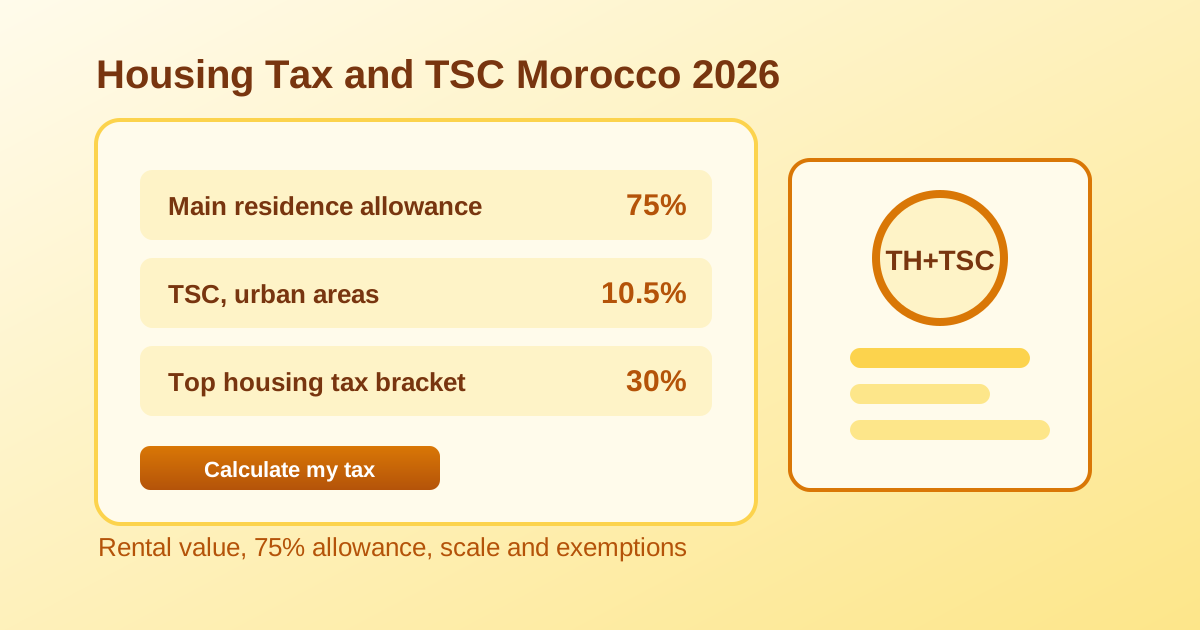
For a primary residence, the law applies a 75% abatement on the rental value. So only 25% of the rental value enters the calculation. This abatement covers the home occupied as a primary residence by the owner, their spouse, or an ascendant or descendant in a direct line to the first degree.
On this reduced base, the housing tax follows a progressive scale by bracket:
| Annual rental value bracket (after abatement) | Housing tax rate |
|---|---|
| 0 to 5,000 MAD | 0% (exempt) |
| 5,001 to 20,000 MAD | 10% |
| 20,001 to 40,000 MAD | 20% |
| Above 40,000 MAD | 30% |
The 0 to 5,000 MAD bracket is exempt. Many modest primary residences fall below the threshold and pay no housing tax after the abatement. To estimate the annual tax on your rents, which differs from the TH, use our rental tax calculator.
The municipal services tax: 10.5% or 6.5%
The municipal services tax applies at a flat rate, with no progressive scale: 10.5% within the perimeter of urban municipalities and delimited centres, and 6.5% in peripheral zones. It funds local services such as waste collection, lighting and roads.
The TSC rests on the same rental value as the housing tax. For a primary residence, the 75% abatement also applies to the TSC: the base is 25% of the rental value too. For a property that is rented out, the TSC is instead based on the amount of the rents, without the primary-residence abatement.
In practice, an owner-occupier pays both TH and TSC on the same reduced base, while a landlord mainly bears the TSC on the rents, on top of the income tax on rental income.
Worked example: a Casablanca apartment as a primary residence
Take an apartment in Casablanca, occupied as a primary residence, whose census commission set the annual rental value at 30,000 MAD. The property is within the urban perimeter.
Step 1, the abatement: 30,000 MAD minus 75% gives a taxable base of 7,500 MAD, shared by the TH and the TSC.
Step 2, the housing tax: the first 5,000 dirhams are exempt, then the bracket from 5,001 to 7,500 MAD (that is, 2,500 MAD) is taxed at 10%. The TH comes to 250 MAD per year.
Step 3, the municipal services tax: 7,500 MAD at 10.5% gives 787.50 MAD per year. The total TH + TSC for this home comes to about 1,037 MAD per year. The amount stays moderate because the primary residence benefits from the 75% abatement on both taxes.
Exemptions to know
The most useful exemption is temporary: new constructions benefit from a housing tax exemption for 5 years from their completion. A new home that you occupy pays no TH during this initial period.
Threshold exemptions also apply: the rental value bracket up to 5,000 MAD after abatement is exempt from TH, and some social housing or single-use properties fall under specific regimes. The primary residence keeps its 75% abatement as long as it is occupied as such.
One point of caution: the 5-year exemption covers the housing tax, not automatically every local obligation. Confirm your exact situation with the tax office that covers the property.
What changes when you rent the property out
As soon as you rent the home out, it is no longer your primary residence: the 75% abatement no longer applies on that basis. The TSC becomes based on the rents received, at 10.5% in an urban zone.
At the same time, the rents enter income tax as property income, with their own rules (standard allowance, income tax scale, withholding tax for some tenants). This is a tax distinct from the TSC. We detail it in our guide rental income tax 2026 and the steps in the property income return.
For an investor, the order of priorities is clear: property income tax weighs more than the TSC in most cases. Model your net yield after income tax first with our rental tax calculator, then add the TSC as an annual cost.
Official sources and key takeaways
Key takeaways: the housing tax and the municipal services tax rest on the administrative rental value, with a 75% abatement for the primary residence on both taxes. The TH follows a scale from 0 to 30%, the TSC a flat rate of 10.5% or 6.5%. New constructions are exempt from TH for 5 years.
Useful sources
- Directorate General of Taxes (DGI): tax.gov.ma
- Law 47-06 on the taxation of local authorities (Dahir 1-07-195)
- Rental income tax Morocco 2026
- Property income return Morocco 2026
- Rental taxation in Morocco 2026
This information is indicative and based on Law 47-06. Rental values and specific cases fall to the census commission and your local tax office. Have your situation validated by a professional or the DGI before any decision.
Frequently asked questions
- What is the difference between the housing tax and the income tax on rental income?
- The housing tax is a local tax based on the rental value of the home. The income tax on rental income is a state tax based on the rents actually collected. A landlord can bear both: the TSC on the property and income tax on the rents.
- Does the 75% abatement also apply to the municipal services tax?
- Yes. For a primary residence, the 75% abatement on the rental value applies to both the housing tax and the municipal services tax. The base is then 25% of the rental value.
- How long does the exemption for a new construction last?
- The housing tax is exempt for 5 years from the completion of the construction. After that period, the home is taxed under the scale, with the 75% abatement if it remains a primary residence.
- How is the rental value set?
- It is determined by the census commission from the average rents of similar properties in the neighbourhood, then revised every 5 years with a 2% increase. It is neither your purchase price nor your actual rent.
- Does a rented home pay the housing tax?
- When the property is rented out, it no longer qualifies for the primary-residence abatement and the municipal services tax becomes based on the rents. For the exact housing-tax treatment in your case, confirm with your local tax office.
Use our Morocco rental profitability calculator
Gratuit · Résultats en 2 minutes