Why simulating your mortgage before approaching a bank gives you an edge
Simulating your mortgage before contacting a bank gives you three concrete advantages: (1) you know your target monthly payment and can verify that the projected rent covers it sufficiently to maintain positive cash flow, (2) you can compare scenarios (rate, term, down payment) to identify the optimal structure before even negotiating, and (3) you arrive at the bank with precise figures that show you have done your homework, which strengthens your credibility and negotiating power.
Our Morocco mortgage simulator calculates in real time the monthly payment, full amortisation table, and total credit cost for any combination of amount, rate, and term. This guide explains the underlying formula, how to interpret the results, and how to integrate them into your rental ROI calculation.
The monthly payment formula: understanding the mechanism
The monthly payment on a fixed-rate mortgage is calculated using the constant annuity formula:
M = C × [r(1+r)^n] / [(1+r)^n − 1]
Where: M = monthly payment, C = loan amount, r = monthly rate (annual rate / 12), n = number of payments (years × 12). This formula ensures each monthly payment is identical throughout the loan, even though the split between capital and interest shifts every month.
Concrete example: 600,000 MAD over 20 years at 5.2%. Monthly rate r = 5.2% / 12 = 0.4333%. n = 240 payments. M ≈ 4,010 MAD/month. Over 20 years, total repaid = 4,010 × 240 = 962,400 MAD, of which 362,400 MAD is interest (60% of the loan amount paid in addition). Our simulator performs this calculation instantly for all your scenarios.
The amortisation table: reading capital and interest month by month
Each monthly payment consists of two parts that evolve over time: (1) the interest for the month = outstanding balance × monthly rate. (2) The capital repayment = monthly payment − interest. Early in the loan, interest accounts for the majority (the outstanding balance is at its maximum) and capital repayment is small. This reverses by the end.
For our example (600,000 MAD, 5.2%, 20 years): Month 1 : interest = 600,000 × 0.4333% = 2,600 MAD, capital = 4,010 − 2,600 = 1,410 MAD. Month 120 : outstanding balance ~365,000 MAD, interest = 1,582 MAD, capital = 2,428 MAD. Month 240 : almost entirely capital. This profile explains why early repayment is especially advantageous at the start of the loan: it reduces a still-high capital base and generates significant interest savings. The full table is available in our mortgage simulator.
Rate impact: what each extra half-point costs you
For a 700,000 MAD loan over 20 years, here is the impact of each rate level on the monthly payment and total interest:
- 4.5% → 4,430 MAD/month, 363,000 MAD total interest
- 5.0% → 4,620 MAD/month, 408,000 MAD total interest
- 5.5% → 4,810 MAD/month, 454,000 MAD total interest
- 6.0% → 5,010 MAD/month, 502,000 MAD total interest
Each extra half-point adds roughly 190 MAD/month to the payment and 45,000 MAD to the total cost over 20 years, worth every hour spent negotiating.
On a rental with 7,500 MAD/month rent and 1,000 MAD/month expenses, moving from 4.5% to 5.5% reduces monthly cash flow from 7,500 − 1,000 − 4,430 = +2,070 MAD to 7,500 − 1,000 − 4,810 = +1,690 MAD. Over 12 months, the gap is 4,560 MAD, more than 90,000 MAD in lost cash flows over 20 years. Test your scenarios in our rental ROI calculator.
Term impact: 15 vs 20 vs 25 years
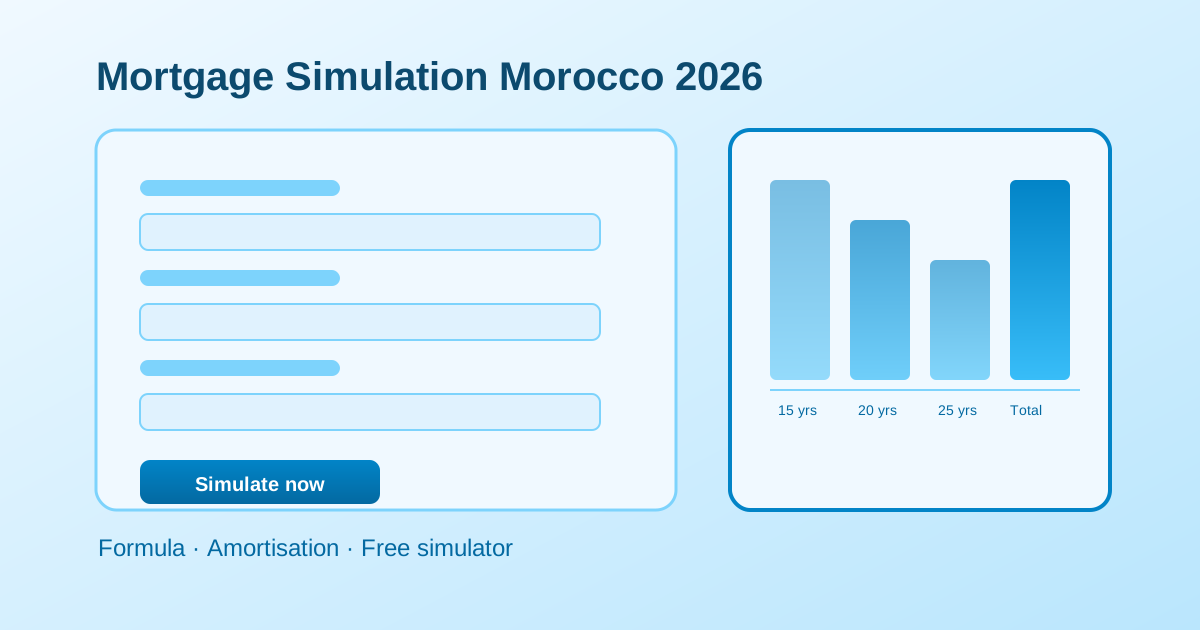
Term affects two opposing axes: a longer term lowers the monthly payment (better for monthly cash flow) but increases total interest cost (worse for long-term return). For a 700,000 MAD loan at 5%:
- 15 years → 5,530 MAD/month, 295,000 MAD total interest
- 20 years → 4,620 MAD/month, 408,000 MAD total interest (+38%)
- 25 years → 4,090 MAD/month, 527,000 MAD total interest (+79%)
Each extra 5 years reduces the monthly payment by ~500 MAD but adds ~115,000 MAD of interest.
For a rental investor, the optimal term depends on the gap between rent and monthly payment. If the rent comfortably covers a 15-year payment, prefer 15 years (substantial interest savings). If cash flow turns negative on 15 years, extend until the payment is covered by net rent after expenses. Simple rule: the payment should not exceed 75–80% of gross rent to leave room for expenses and vacancy. Simulate all three terms in our mortgage simulator.
Costs to include in a complete simulation
A rigorous simulation goes beyond the base monthly payment. Include: (1) Borrower insurance (0.3–0.6% of capital/year, about 175–350 MAD/month on 700,000 MAD). (2) Origination fees (1–2% of loan amount, payable at signing, amortise over the term in your ROI calculation). (3) Mortgage registration fees (~1.5% of loan amount, included in acquisition costs). (4) Property valuation (1,500–4,000 MAD depending on the property). Together these elements constitute the actual TAEG of your loan, always higher than the nominal rate advertised.
For a complete simulation: add the monthly insurance to the base payment to get the total monthly payment to budget. Origination and registration fees are upfront costs to include in your initial outlay (alongside standard acquisition fees). Our guide on origination fees and insurance details each item and how to calculate it.
Integrating the simulation into your rental ROI calculation
Once you have your simulated total monthly payment (loan + insurance), plug it into the ROI calculation as follows: Monthly cash flow = Rent − Total monthly payment (loan + insurance) − Recurring expenses − IR provision. If positive, the project generates a monthly surplus. Cash-on-cash ROI = (annual cash flow / own capital invested) × 100.
Example: property at 900,000 MAD, 25% down (225,000 MAD) + 7% acquisition costs (63,000 MAD) = 288,000 MAD own capital. Loan 675,000 MAD at 5.2% over 20 years → base payment 4,510 MAD + insurance 200 MAD = total 4,710 MAD/month. Rent 7,500 MAD, expenses 900 MAD, IR provision 180 MAD. Cash flow = 7,500 − 4,710 − 900 − 180 = +1,710 MAD/month. ROI = (1,710 × 12) / 288,000 = 7.1%. Simulate your exact scenario in our ROI calculator. The numbers speak: simulating before buying is the most profitable decision you can make.
Common mistakes in mortgage simulations
Mistake 1: forgetting insurance in the monthly payment. The payment shown by banks is often exclusive of insurance. Always add 175–350 MAD/month depending on the profile. Mistake 2: using the nominal rate instead of the TAEG. The TAEG includes all costs and is the true cost of your loan. Mistake 3: simulating the loan but not its impact on ROI. An affordable payment is not necessarily a profitable investment. Always check cash flow and cash-on-cash ROI.
Mistake 4: not testing multiple terms. Many borrowers default to 20 years. Test 15 and 25 years too: depending on rent levels, 15 years may be easily affordable and saves over 100,000 MAD in interest. Mistake 5: ignoring vacancy. A simulation assuming 100% occupancy is unrealistic. Provision at least 1 month of vacancy per year (8%) in your figures. Our mortgage simulator and ROI calculator help you avoid all five mistakes.
FAQ + resources on Morocco mortgage simulation 2026
- How do I calculate my monthly payment without a simulator? Use the formula M = C × [r(1+r)^n] / [(1+r)^n − 1] with r = annual rate/12 and n = term in months. Or use our free simulator directly.
- What is my maximum debt-to-income ratio? Moroccan banks generally cap the total monthly payment (loan + insurance) at 40–45% of net monthly income. Below this threshold, the application is generally receivable.
- Can you repay early in Morocco? Yes, but early repayment fees may apply (typically 3% of the early repayment amount, capped at 6 months' interest). Check the conditions in your contract.
- Does the simulator account for inflation? Our simulator calculates in nominal terms. Over 20–25 years, rents generally track inflation, which improves real cash flow over time.
Useful references
Use our Morocco rental profitability calculator
Gratuit · Résultats en 2 minutes