Ancillary mortgage costs: what banks underplay
When a bank advertises a rate of 5.0%, that figure represents only part of the true cost of your loan. Ancillary fees : origination fees, mandatory borrower insurance, security fees, and property valuation, can add the equivalent of 1 to 3 extra percentage points to the total cost. Understanding, quantifying, and negotiating these fees is an essential step in calculating your real TAEG and building it into your rental ROI simulation.
This guide reviews each fee category with real 2026 amounts, explains how to compare them across lenders, and shows you how to incorporate them into our ROI calculator for projections that accurately reflect reality.
Origination fees: amounts, mechanics, and negotiation scope
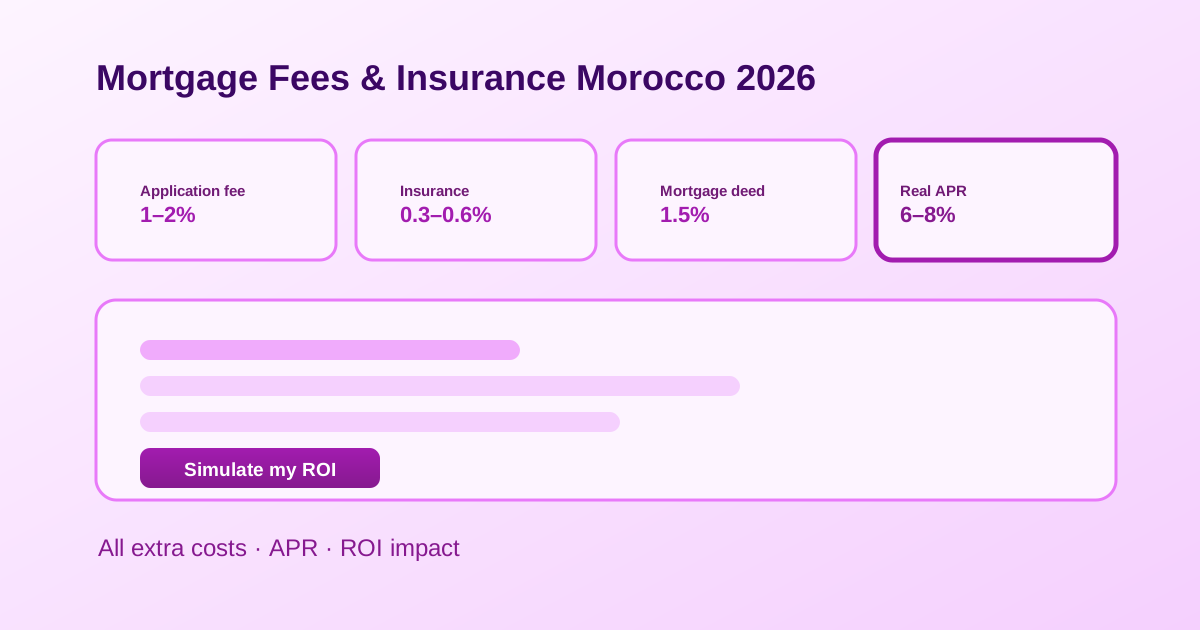
Origination fees compensate the bank for processing your mortgage application (risk analysis, administrative processing, file assembly). They are expressed as a percentage of the loan or as a fixed fee. In Morocco in 2026, the range is typically 1% to 2% of the loan amount, sometimes with an absolute cap (e.g. 8,000–12,000 MAD maximum depending on the institution).
For an 800,000 MAD loan, origination fees represent between 8,000 and 16,000 MAD. They are due at signing and are not refunded on early repayment. The good news: they are frequently negotiable : a 30–50% reduction is achievable for strong files or when banks compete directly. Some institutions waive them during promotional periods or for first-time buyers. Always ask explicitly for a waiver or reduction in exchange for salary domiciliation or as part of competitive tendering.
Borrower insurance: mandatory, calculated on initial capital
Borrower insurance is a mandatory condition for obtaining a mortgage in Morocco. It guarantees repayment of the outstanding balance in the event of the borrower's death or total and permanent disability. Some contracts also include temporary incapacity to work (ITT) coverage. The premium rate typically ranges from 0.30% to 0.60% of the initial capital per year, depending on age and health.
Key point: in Morocco, insurance is most often calculated on the initial capital (not the outstanding balance). This means the monthly premium remains constant throughout the loan, even as the capital reduces with repayments. For an 800,000 MAD loan at 0.40%/year: annual premium = 3,200 MAD, i.e. 267 MAD/month fixed for 20 years. Some institutions offer decreasing insurance (calculated on the outstanding balance) which is more advantageous over time, the gap over 20 years can exceed 20,000 MAD. Compare both formulas explicitly, as this single factor sometimes changes which lender is actually cheapest in total.
Mortgage security and registration fees
To secure the loan, the bank requires a guarantee over the financed property. The most common form in Morocco is a first-ranking mortgage, registered with ANCFCC (Agence Nationale de la Conservation Fonciere du Cadastre et de la Cartographie). Mortgage registration fees amount to approximately 1.5% of the loan amount and are paid when signing the notarised deed of sale.
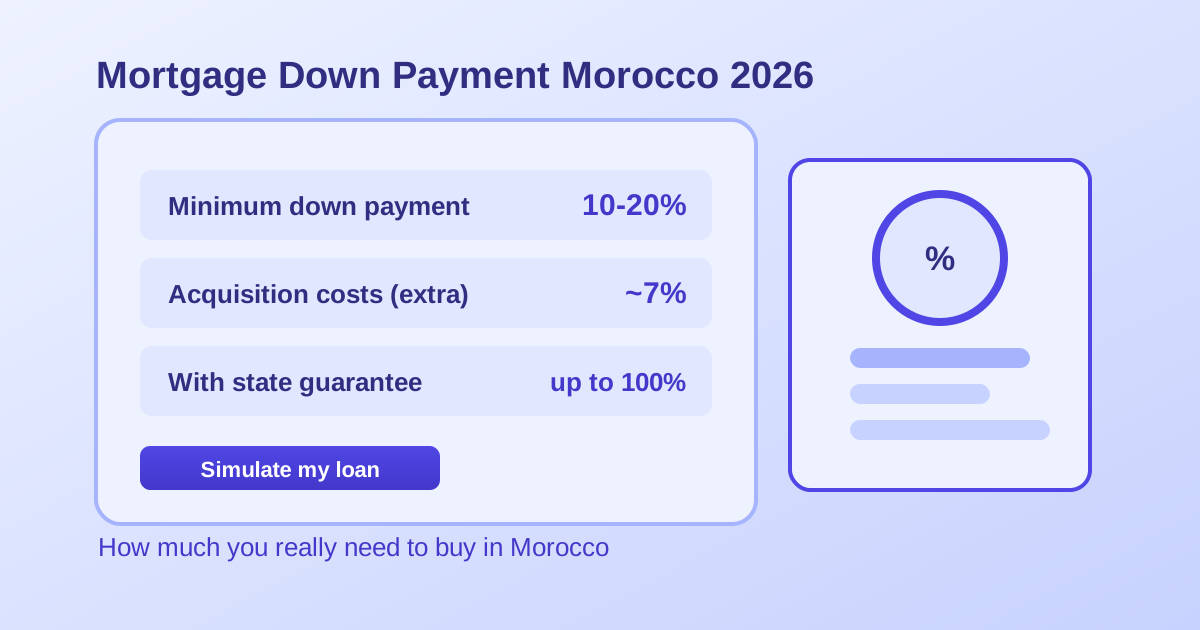
For a 700,000 MAD loan, mortgage fees amount to approximately 10,500 MAD. These are acquisition-stage costs (one-time entry fees, not recurring) and must be included in the calculation of total own capital invested alongside transfer duties and notary fees. Some banks offer alternative guarantees (pledge, mutual guarantee) which may be cheaper, check what is available for your situation.
Property valuation fee: mandatory for setting the guarantee value
Before granting the loan, the bank commissions an accredited property valuer to assess the market value of the property and from it the mortgage guarantee value. This valuation is charged to the borrower and typically costs between 1,500 and 4,000 MAD depending on the type of property, its size, and its location. Atypical properties (farms, commercial premises, mixed-use buildings) may require more complex and costly assessments.
If the assessed value is below the purchase price, the bank may cap the loan at a percentage of the assessed value, which can increase the required down payment. It is useful to know the estimated market value in advance and verify that it is consistent with the purchase price. ANCFCC price indices and comparable listings can help validate your estimate before signing the preliminary agreement.
The real TAEG: calculating the true total cost of your loan
The TAEG (Annual Effective Global Rate) includes the nominal rate, origination fees, insurance, and all recurring loan-related costs. It is the indicator that enables valid comparison between two offers. On a 700,000 MAD loan over 20 years at 5% nominal + 1.5% origination fees + 0.40%/year insurance, the real TAEG sits around 5.9–6.2% depending on how fees are treated.
To compare two offers rigorously: demand the total credit cost over the full term from each bank: total monthly payments + total insurance + origination fees + security fees. This global figure is what enables objective comparison, not the nominal rate alone. A bank at 4.9% with 2% origination fees and 0.55% insurance may cost more than a bank at 5.2% with waived fees and 0.30% insurance. The real TAEG does not lie, request it in writing.
How to reduce these fees: lever by lever
Origination fees: negotiate a discount or waiver in exchange for salary domiciliation or competitive tendering. Promotions at the start of the year or end of quarter are common. Insurance: compare the cost on initial capital vs outstanding balance, and ask whether the bank accepts external insurance (delegation). In France, insurance delegation is a right; in Morocco it is less systematic but some institutions accept it.
Security fees: in some cases a mutual guarantee can replace the mortgage and be cheaper. Ask your bank. Valuation: the amount is generally non-negotiable as it is conducted by independent valuers. Simply make sure the property is assessed at fair value to avoid a discount on your financing. Early repayment: negotiate favourable terms at signing (reduced or zero penalties) if you are planning to repay early. In a rental investment, retaining this option preserves flexibility if you sell the property before the end of the loan.
Incorporating all fees into your ROI calculation
All entry fees (origination fees, mortgage registration, valuation) are added to standard acquisition costs (transfer duties, land registry, notary) when calculating total own capital invested. Recurring fees (monthly insurance) are added to the loan payment when calculating monthly cash flow.
Full example on a 700,000 MAD loan at 5% over 20 years: base payment = 4,620 MAD + insurance 240 MAD = total monthly payment 4,860 MAD. Entry loan costs: origination 10,500 MAD + mortgage 10,500 MAD + valuation 2,500 MAD = 23,500 MAD. These 23,500 MAD are added to the down payment and acquisition costs (~7% of the price) in your own-capital calculation. Enter the total monthly payment of 4,860 MAD into our ROI calculator and add 23,500 MAD to the invested capital for an accurate and reliable cash-on-cash ROI.
FAQ + resources on Morocco mortgage fees 2026
- Are origination fees tax-deductible? In the flat-rate rental income regime, no, the 40% deduction is supposed to cover all costs. In the actual-expenses regime, yes, they can be deducted as setup costs or amortised.
- Can borrower insurance be arranged with an external insurer? Theoretically yes (insurance delegation), but in practice Moroccan banks prefer their in-house products. Some institutions accept it on a case-by-case basis, ask explicitly.
- Are mortgage registration fees refundable if I repay the loan early? No, registration fees are definitive. But the mortgage discharge itself generates additional fees (roughly 0.5% of the amount) to budget for if you sell before the loan ends.
- Can fees be rolled into the loan? Generally no: Moroccan banks finance the property but not ancillary fees, which must be covered by personal contribution.
Useful references
Use our Morocco rental profitability calculator
Gratuit · Résultats en 2 minutes