What is withholding tax on rent in Morocco?
Withholding tax (RAS) on rent is a mechanism by which the tenant (when it is a legal entity or a professional) deducts income tax on the rental income at source when paying the rent, then remits it directly to the tax authority. So the tenant bears the responsibility for paying the tax, not the landlord. This system exists to secure tax collection in commercial relationships where landlords might otherwise not declare their income.
It is important to distinguish the RAS from the standard IR regime on rental income: these are two different mechanisms that apply in different situations. A landlord renting to an individual is in the standard IR regime (annual declaration, 40% deduction). A landlord renting to a company or professional may be subject to withholding tax. Understanding this distinction lets you correctly model the tax charge in your ROI simulation.
Who is affected by withholding tax on rent?
The RAS on rent applies when the tenant is a legal entity (company, association, public body) or a professional subject to business tax who rents a property for professional or commercial use. In practice: if you rent your property to a company to house its offices, commercial premises, or operations, your tenant is required to apply withholding tax on each rent payment.
By contrast, if your tenant is an individual (natural person) renting your property as their personal residence, the RAS does not apply. You fall under the standard rental income regime with annual declaration and 40% deduction. The vast majority of residential properties rented to individuals are not affected by withholding tax, but it is essential to check your tenant's status, particularly for mixed-use premises or business co-lettings.
The withholding tax scale for rent in Morocco 2026
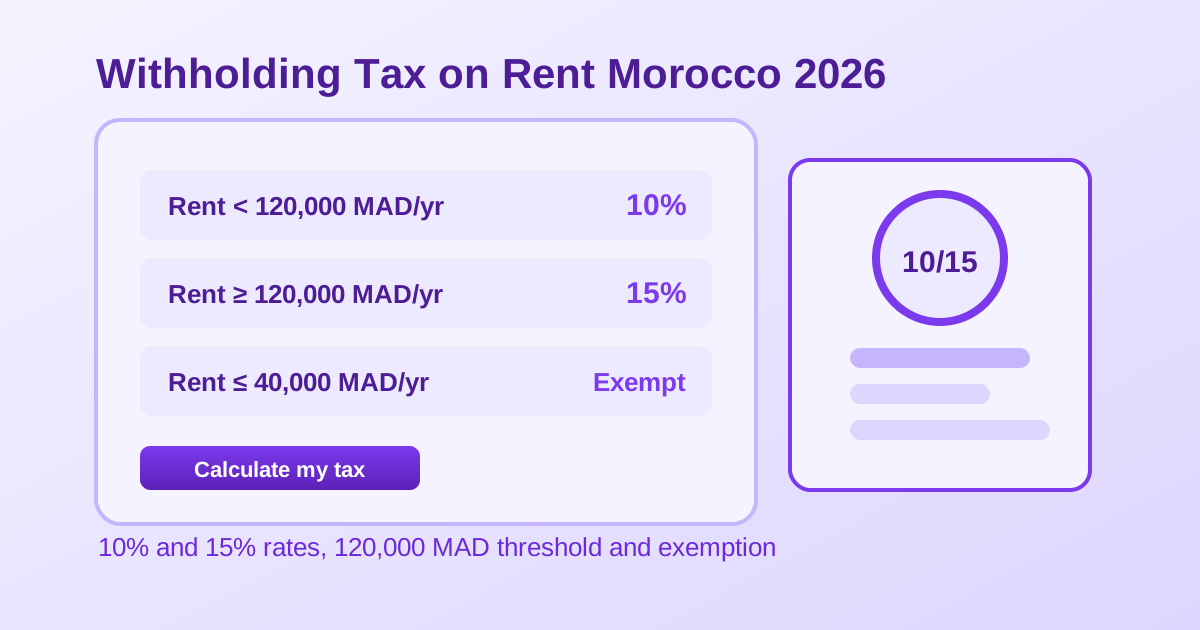
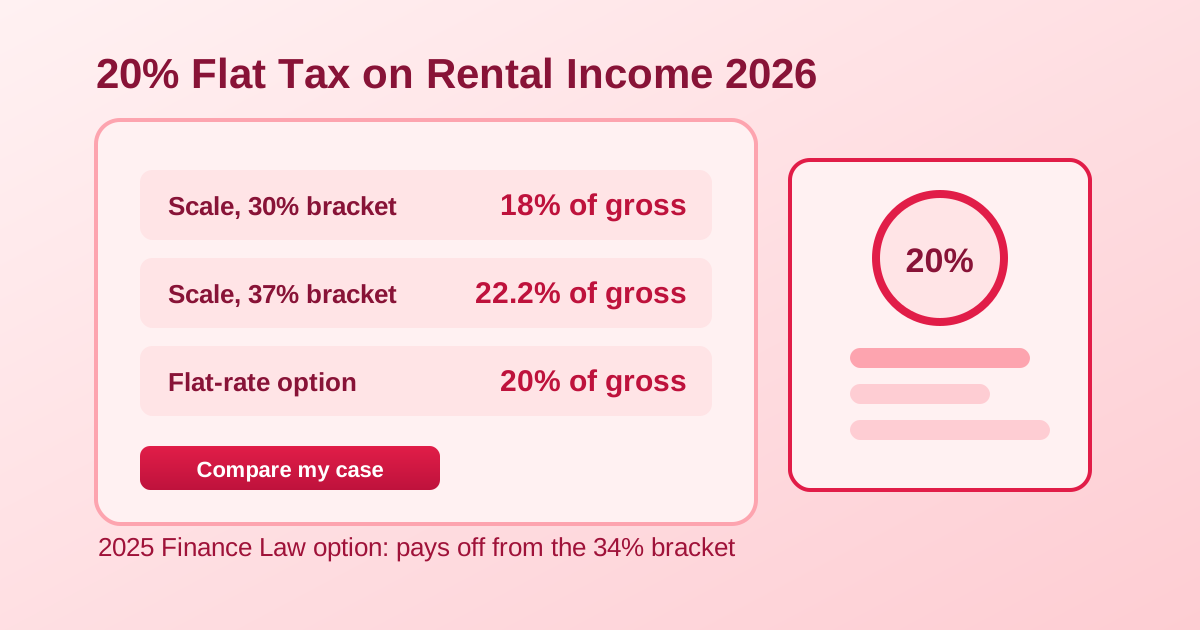
The withholding scale on rent paid to individuals has two tiers, set by articles 160 bis, 173 and 73-II of the CGI: 10% when the gross annual taxable rent paid to the same owner is below 120,000 MAD, and 15% when it reaches or exceeds 120,000 MAD. The rate applies to the whole gross amount, not bracket by bracket: at 130,000 MAD/year, the full 130,000 MAD is withheld at 15%. The tenant is dispensed from withholding when annual gross rent does not exceed 40,000 MAD (30,000 MAD before the 2025 Finance Law). Since 2025 the owner can also opt for a final 20% withholding, covered in our flat-rate option guide. All thresholds and worked cases are in our detailed 2026 RAS scale.
This 10% or 15% withholding is an advance on the landlord's IR, not necessarily the final tax amount. At year end, the landlord declares their rental income with the 40% deduction, calculates actual IR using the progressive scale, and compares with withholding tax already paid. If the RAS exceeds the calculated IR, the surplus is refundable. If it falls short, a balance is due. Always verify current rates on the DGI portal as they may be adjusted by the annual Finance Law.
How it works in practice: who pays what and when
The mechanism works as follows: (1) The tenant (legal entity) pays the landlord 90% or 85% of the rent each month depending on the applicable rate (10% below 120,000 MAD/year, 15% at or above) and retains the rest. (2) The tenant declares and remits the withheld amount to the tax office they fall under, generally within the month following payment. (3) The tenant issues the landlord a withholding tax certificate stating the amounts withheld and remitted. (4) The landlord incorporates these retentions in the annual IR declaration as a tax credit.
This certificate is a key document: keep it carefully as it lets you justify the retentions to the tax authority and validate the corresponding tax credit when you file. If you are unsure whether the RAS applies to your tenant or situation, consult your local tax office or a tax adviser. An error in applying (or not applying) the RAS can expose the tenant to significant penalties.
Step-by-step calculation: commercial rent of 12,000 MAD/month
A landlord rents a commercial space to an LLC for 12,000 MAD/month, which is 144,000 MAD/year. That amount reaches the 120,000 MAD threshold, so the applicable rate is 15%, not 10%. The LLC pays the landlord 10,200 MAD and remits 1,800 MAD to the Treasury each month. At year end: gross annual rent = 144,000 MAD. Total RAS paid during the year = 21,600 MAD.
Calculating the landlord's actual IR: taxable base after 40% deduction = 144,000 × 60% = 86,400 MAD. Progressive scale: 0 MAD (40,000) + 2,000 MAD (20,000 at 10%) + 4,000 MAD (20,000 at 20%) + 1,920 MAD (6,400 at 30%) = total IR = 7,920 MAD. The withholding tax paid (21,600 MAD) far exceeds the actual IR (7,920 MAD): the surplus of 13,680 MAD is refundable or can be offset against other tax liabilities. Enter the net rent actually received (10,200 MAD/month) into our ROI calculator for an accurate simulation.
Withholding tax vs standard rental IR: comparison table
Who it applies to: Standard IR → rental to an individual. Withholding tax → rental to a legal entity or professional. Who pays: Standard IR → the landlord (annual declaration). Withholding tax → the tenant deducts and remits each month. Rate: Standard IR → progressive scale 0-37% on base after 40% deduction. Withholding tax → 10% or 15% on gross depending on the 120,000 MAD threshold (advance on IR, settled at year end). Declaration: Standard IR → landlord files by 1 March N+1 on Simpl-IR. Withholding tax → tenant files and remits monthly; landlord incorporates in annual declaration. Cash flow impact: Standard IR → landlord receives 100% of rent monthly and pays IR annually. Withholding tax → landlord receives 90% or 85% monthly depending on the applicable rate (but may recover RAS surplus at year end).
For cash flow planning: the RAS reduces your monthly receipt by 10% or 15% depending on the 120,000 MAD threshold, but avoids a large annual payment. The final profitability impact is similar, but the cash flow timing differs. Model your monthly cash flow in our ROI calculator based on the net rent received (after withholding) for a realistic picture.
Filing obligations: tenant and landlord responsibilities
Tenant obligations (withholding debtor): declare and remit the RAS within the month following each rent payment, to the tax collector they report to. Issue the landlord an annual certificate of withholding performed. Maintain a register of withholdings made. Penalties for failure to remit withheld tax can be significant for the tenant.
Landlord obligations: declare rental income in the annual IR declaration by 1 March, even if withholding tax has been applied. Credit the RAS against the IR due. Retain withholding certificates provided by the tenant. Verify at year end whether actual IR exceeds or falls short of the RAS: pay the balance in the first case, claim a refund in the second. Consult the DGI portal or your local tax centre for exact procedures.
Impact on rental ROI: how to incorporate withholding tax in your calculations
In a commercial letting subject to withholding tax, your effective monthly receipt is 90% or 85% of the nominal rent (10% withheld below 120,000 MAD/year, 15% at or above). This is the figure that should drive your cash flow calculation, not the gross rent. At year end you may recover a RAS surplus (if actual IR is below the amounts withheld), but this refund is not immediate and should not be counted in monthly cash flow.
For a rigorous ROI projection: (1) Enter the net monthly rent received (gross × 90% or × 85% depending on the applicable rate) as income in our ROI calculator. (2) Calculate actual year-end IR using the 40% deduction and progressive scale method. (3) If actual IR is below total RAS paid, incorporate the expected refund into annual projections. (4) If actual IR exceeds total RAS, provision the balance. This method ensures your simulation accurately reflects the financial reality of your investment.
FAQ + resources on withholding tax on rent in Morocco 2026
- Is the 10% or 15% withholding my final tax rate? No, it is an advance. Your final IR is calculated at year end using the progressive scale after the 40% deduction. Any RAS surplus is recoverable.
- Does my individual tenant need to apply withholding tax? No, individuals are not required to operate the RAS. Only legal entities and certain professionals are obligated.
- What if my tenant forgets to apply the RAS? The tenant is at fault and faces penalties. As the landlord, you remain liable for IR on that income and must declare it normally.
- Does the RAS apply to overdue rent? Yes, the RAS applies at the time of actual payment, not the theoretical due date.
Useful references
Use our Morocco rental profitability calculator
Gratuit · Résultats en 2 minutes