Why MREs are a key segment of the Moroccan property market
Moroccans Residing Abroad (MRE) represent one of the most active buyer segments in the Moroccan real estate market. With more than 5 million people concerned (primarily in France, Spain, Italy, Belgium and the Netherlands) MREs regularly invest in Morocco to prepare for retirement, diversify their wealth or support family members. Their financial transfers represent several billion euros per year.
Buying property in Morocco from abroad has specific features that Moroccan banks have progressively adapted to. Dedicated credit products, digitalised processes and local European branches now allow MREs to obtain Moroccan mortgage financing without constant travel. This guide explains the conditions, the banks to contact and the key watch points for a successful application.
Which banks serve MREs in Morocco in 2026?
Banque Populaire is historically the reference bank for MREs, through its Banque Chaabi network established across Europe (France, Spain, Italy, Belgium, the Netherlands, Germany). You can initiate your application at your local Chaabi branch in euros or dirhams, with a French-speaking contact. Banque Populaire also has a dedicated MRE digital portal.
Attijariwafa Bank is present in Europe through its subsidiaries (Attijari Europe in Spain, branches in France) and offers home loans to MREs. CIH Bank has also developed an MRE offering and can be contacted digitally or by phone directly from Morocco or abroad. BMCE Bank of Africa and Societe Generale Maroc complete the panel.
It is advisable to contact at least two banks to compare offers. Rates and conditions can vary significantly by institution, term, amount and currency. Use our mortgage payment simulator to evaluate the impact of each financing scenario on your monthly payment and your rental ROI.
Rates and specific conditions for MREs
In 2026, rates for MREs are generally aligned with the local market: between 4.5% and 5.8% fixed for a MAD-denominated mortgage. Some banks offer preferential rates for MREs with strong profiles (high down payment, stable income, solid banking history), potentially as low as 4.5%. Foreign-currency (EUR) rates may differ and depend on European market conditions.
Eligibility conditions for MREs are similar to residents, with some adaptations: foreign income is accepted (European pay slips, home-country tax returns), the debt-to-income ratio is calculated on total net income, and repayment capacity can be assessed in currency. Some banks require partial salary domiciliation to grant the best rates.
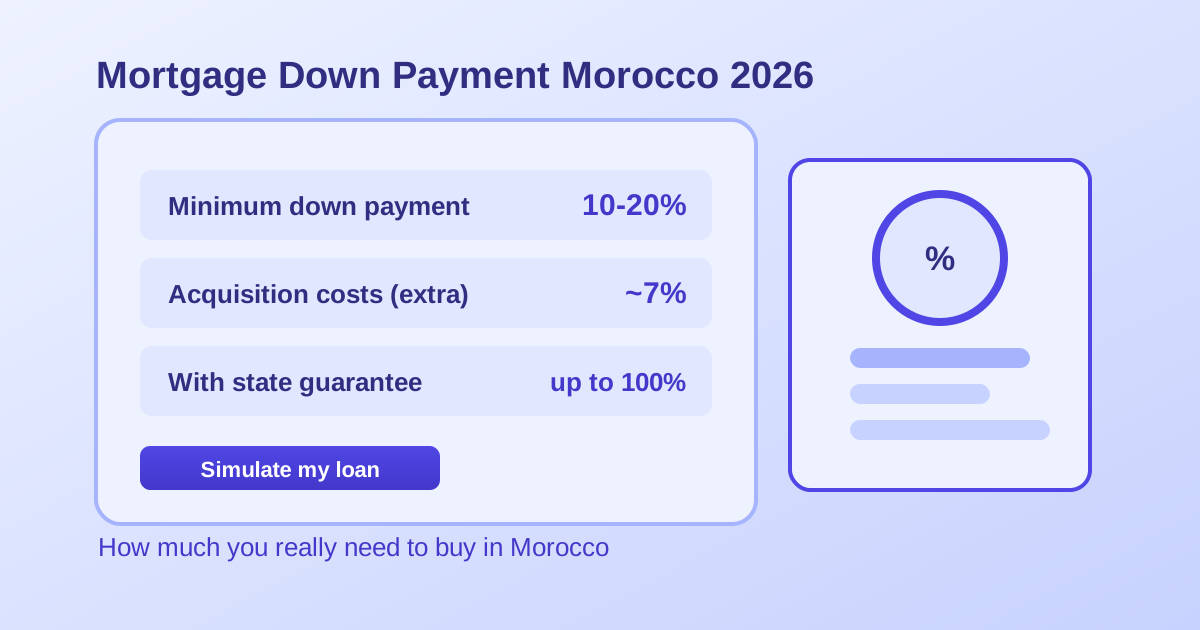
The minimum down payment is generally 20–25% of the purchase price, plus acquisition costs (~7%). An MRE investing in a MAD 1,000,000 property will need to mobilise between MAD 270,000 and MAD 320,000 in own funds. Check in our ROI calculator how this down payment level influences your final cash-on-cash ROI.
Required documents for an MRE application
Identity and residence documents: valid Moroccan passport, residence permit or residence card of the host country, proof of address abroad (utility bill, rental agreement). Some banks also require the CIN for Moroccan legal aspects.
Income documents: last 3 pay slips (translated if not in French or English for some institutions), most recent home-country tax return, employment contract or proof of self-employed activity. For the self-employed or business owners, accounts for the last 2–3 financial years may be requested.
Property documents: sale agreement or preliminary contract, plan and floor area of the property, quotes for any renovation works. The bank will commission an accredited appraiser to establish the mortgage security value. Also prepare proof of down payment origin (Moroccan and/or foreign bank statements showing the source of funds).
Financing in MAD vs foreign currency: which to choose?
A MAD (dirham) mortgage is the most common option. You borrow in dirhams and repay in dirhams via international transfers. The monthly payment is fixed and predictable in MAD. Currency risk exists if your income is in euros: a depreciation of the euro against the dirham increases the real cost of your monthly payment in euros. Historically EUR/MAD has been relatively stable (around 10–11 MAD per EUR), but this can evolve over a 20-year mortgage horizon.
A foreign-currency (EUR) mortgage is sometimes offered by the European subsidiaries of Moroccan banks to their MRE clients. You repay in your income currency, eliminating currency risk on the repayment side. But European interest rates in 2025–2026 are significantly higher than they were before 2022, and this type of structure is less common.
For most MREs, a MAD mortgage remains the simplest and most appropriate choice. Build in a small currency buffer in your projections to absorb exchange rate variations, especially on a 15–20 year horizon. Our mortgage simulator lets you test different rates and see the exact impact on your monthly payment.
Process and timelines: from application to signing
The process starts with a preliminary study (simulation, agreement in principle) that can often be done online or by email with basic documents. This step usually takes 1–2 weeks. The full file review (income analysis, property valuation, legal verification) can then take a further 4–8 weeks depending on case complexity and how quickly both parties respond.
The sale deed and mortgage agreement signature takes place before a notary in Morocco. Most MREs need to plan one or two trips to Morocco during the process: one to visit and sign the preliminary contract, another for the final deed. Power of attorney solutions exist for certain steps, but the authentic deed signature before a notary generally requires physical presence or a notarised power of attorney.
Plan the process with a 4–6 month margin between your investment decision and the final signing. Many MREs coordinate their banking file remotely and finalise everything in a few days during a planned trip to Morocco. To speed things up, prepare all documents in advance and choose a responsive notary.
Calculating ROI as an MRE investor
For an MRE, profitability is calculated the same way as for a resident: gross yield, net yield and cash-on-cash ROI. The specific factors to account for are: remote management cost (Moroccan rental management agency, typically 8–12% of rents), vacancy risk that is slightly harder to manage remotely, and Moroccan rental income tax (see our rental income tax guide).
Example: property at MAD 900,000 in Tangier, rent MAD 6,500/month. Down payment 25% (MAD 225,000) + acquisition costs 7% (MAD 63,000) = MAD 288,000 in own funds. Mortgage: MAD 675,000 over 20 years at 5.2%, monthly payment ~MAD 4,510. Monthly costs: syndic MAD 800 + management MAD 650 + provisions MAD 300 = MAD 1,750. Monthly cash flow: 6,500 - 4,510 - 1,750 = +MAD 240/month. Cash-on-cash ROI: (240 × 12) / 288,000 = ~1%.
This modest ROI illustrates the importance of choosing a property with a good rent-to-price ratio and negotiating the rate. On a similar property at MAD 750,000, or with a rent of MAD 7,000/month, the cash-on-cash ROI rises significantly. Run your own numbers in our ROI calculator and adjust the parameters to find the optimal scenario.
FAQ + resources on MRE Morocco mortgage 2026
- Can I buy without going to Morocco? Partially. Pre-study and preliminary contract can be done remotely, but the final deed before a notary generally requires physical presence or a notarised power of attorney.
- Are foreign income documents accepted? Yes, all major Moroccan banks accept foreign income for MREs. Provide translated pay slips and tax returns if required.
- Are there special tax benefits for MREs? MREs investing in Morocco have the same rights as residents for rental income. Repatriation of rents and capital gains is generally permitted through official banking channels.
- How to manage the property from abroad? Through a Moroccan property management agency (8–12% of rents). Some agencies offer full service: letting, rent collection, maintenance and monthly reporting.
Useful references
Use our Morocco rental profitability calculator
Gratuit · Résultats en 2 minutes