The revaluation coefficient: the tool that cuts your resale tax
When you resell a property in Morocco, you pay the real estate profits tax (taxe sur les profits immobiliers, TPI) on the capital gain. The revaluation coefficient is the mechanism that updates your purchase price for inflation. By inflating the acquisition cost, it mechanically reduces the taxable profit, and with it the tax you owe.
These coefficients are set each year by a decree of the Minister of the Economy and Finance. The 2026 ones were published in Official Bulletin No. 7486 of 26 February 2026 (decree of 6 February 2026). This article gives the key values, the method to apply them and a full worked example.
What the coefficient does in the TPI calculation
The TPI is governed by Articles 61 to 65 and 144 of the General Tax Code (CGI). It taxes the net profit realised when an individual sells a property: sale price minus the acquisition price, the acquisition costs and the documented investment expenses.
The key point: the acquisition price and the costs are not kept at their original amount. They are first revalued by multiplying them by the coefficient matching their year of spending. A dirham spent in 2010 is not worth a dirham of 2026, and the coefficient corrects that monetary erosion.
The result: the older your property, the higher the coefficient, and the larger your revalued acquisition cost. That reduces the taxable profit. For the full TPI calculation, see also our capital gains guide.
The 2026 revaluation coefficients
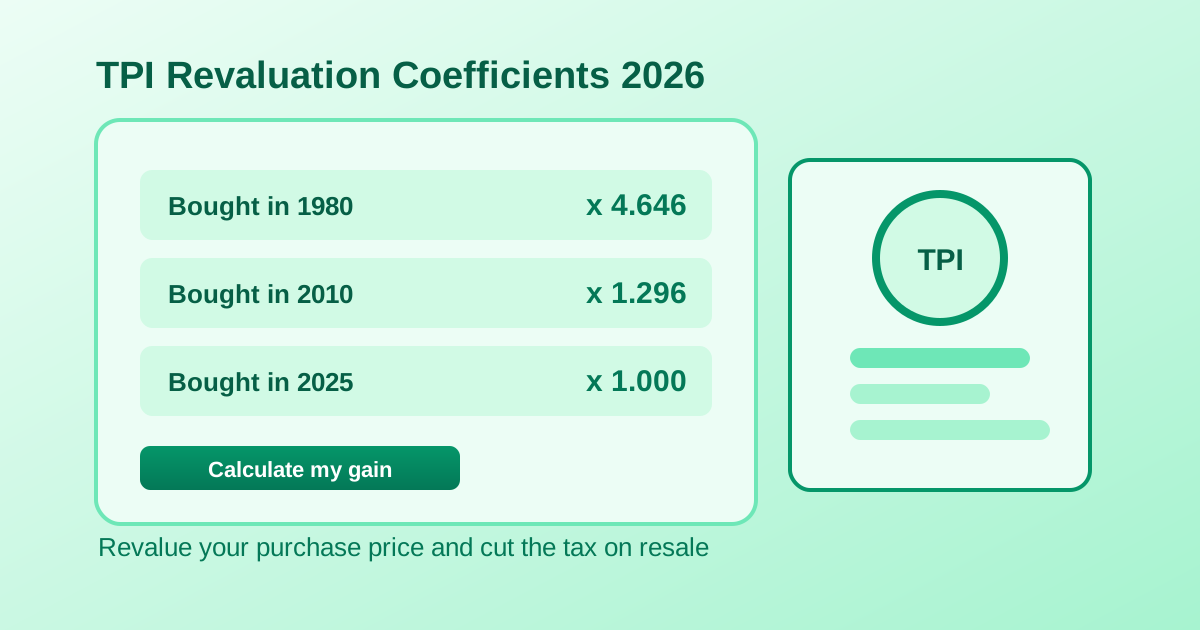
Here are reference values from the 2026 decree, by year of acquisition:
| Year of acquisition | 2026 revaluation coefficient |
|---|---|
| 1980 | 4.646 |
| 2000 | 1.585 |
| 2010 | 1.296 |
| 2022 | 1.078 |
| 2024 | 1.008 |
| 2025 | 1.000 |
The principle reads easily: the reference-year coefficient (2025 for 2026 sales) is 1.000, and it rises the further back you go. For acquisitions before 1946, the coefficient is set on a flat basis at a rate of 3% per year.
The full year-by-year table appears in the decree published in Official Bulletin No. 7486 and on the Directorate General of Taxes simulator. Always check the exact coefficient for your purchase year before calculating.
How to apply the coefficient, step by step
Step 1: identify the property's year of acquisition and the matching 2026 coefficient.
Step 2: multiply the acquisition price by that coefficient. Do the same, with the coefficient of their own year, for the acquisition costs (registration duties, land registry, notary) and for the documented investment expenses (works, extension).
Step 3: add these revalued amounts to get the updated acquisition cost, then subtract it from the sale price. The resulting profit is the TPI base.
Worked example: an apartment bought in 2010, resold in 2026
Take an apartment bought for 800,000 MAD in 2010, with 56,000 MAD of acquisition costs, resold for 1,500,000 MAD in 2026. The 2026 coefficient for a 2010 acquisition is 1.296.
Revalued acquisition price: 800,000 x 1.296 = 1,036,800 MAD. Revalued costs: 56,000 x 1.296 = 72,576 MAD. Total updated acquisition cost: 1,109,376 MAD.
Taxable profit: 1,500,000 minus 1,109,376 = 390,624 MAD. TPI at 20%: 78,125 MAD. The 3% minimum contribution on the sale price would be 45,000 MAD, but since the calculated TPI is higher, that is what applies.
Without revaluation, the profit would have been 1,500,000 minus 856,000 = 644,000 MAD, a TPI of 128,800 MAD. So the coefficient saves more than 50,000 MAD of tax in this single example.
Rate, minimum contribution and primary-residence exemption
The TPI is 20% of the net profit, with a minimum contribution of 3% of the sale price. Even if your revalued profit is low or nil, you still pay at least 3% of the sale price.
The primary residence is exempt if it has been effectively and continuously occupied for at least 6 years on the sale date. An important nuance: if the sale price exceeds 4,000,000 MAD, a 3% contribution applies to the portion above that threshold.
Other exemptions exist, such as some low-value sales or gifts between ascendants and descendants. Check your exact situation, because the duration and price conditions are strict.
Common mistakes and good habits
The most costly mistake is forgetting to revalue the costs and the works. Many sellers only update the purchase price and leave out the registration duties, the notary and the investment expenses, which artificially inflates the taxable profit.
Second habit: keep all supporting documents (purchase contract, cost receipts, works invoices). Without proof, the administration can refuse to include an expense in the acquisition cost.
Finally, you can request an advance ruling from the administration to secure the calculation before the sale. To estimate your total profitability before reselling, use our calculator.
Official sources and key takeaways
Key takeaways: the revaluation coefficient updates your purchase price for the TPI calculation. It is 1.000 for the reference year and rises for older properties. The TPI stays at 20% of the profit, with a 3% minimum contribution on the sale price, and the primary residence is exempt after 6 years of occupation.
Useful sources
- Directorate General of Taxes (DGI): tax.gov.ma
- Decree of 6 February 2026, Official Bulletin No. 7486
- General Tax Code, Articles 61 to 65 and 144
- Real estate capital gains tax in Morocco 2026
- Property acquisition costs in Morocco
This information is indicative and based on the CGI and the 2026 decree. The exact coefficients and specific cases fall to the DGI. Have your calculation validated by a notary or a professional before any sale.
Frequently asked questions
- What is the revaluation coefficient for the TPI?
- It is a multiplier published each year by decree that updates your purchase price according to its year. It inflates the acquisition cost to account for inflation which reduces the taxable profit on resale.
- Where can I find the exact coefficient for my purchase year?
- In the decree published in Official Bulletin No. 7486 of 26 February 2026 and on the Directorate General of Taxes simulator. The coefficient depends on the year of the expense.
- Does the coefficient also apply to costs and works?
- Yes. The acquisition price, the acquisition costs and the documented investment expenses are each revalued by the coefficient of their own year. Forgetting the costs needlessly increases your tax.
- What is the TPI rate in 2026?
- The TPI is 20% of the net profit, with a minimum contribution of 3% of the sale price. The primary residence is exempt after 6 years of continuous occupation, subject to a price condition.
- Can revaluation cancel the tax entirely?
- It can sharply reduce the taxable profit, but the 3% minimum contribution on the sale price remains due in most cases, unless an applicable exemption such as the primary residence applies.
Use our Morocco rental profitability calculator
Gratuit · Résultats en 2 minutes